Five Black Women Rapper Fashion Lines You Might Not Remember

fashionlines.jpg

by Nadirah Simmons

Black women are always setting trends, from hair to makeup to clothing. Thus, it’s no surprise that Black women rappers, in all of their visibility and straight up coolness are the ones at the forefront of what’s in and of course, what’s not. And when you learn that celebrity fashion lines date all the way back to the 1800s, it makes sense that Black women who rap would follow in the tradition and become the faces of their own. 

Vogue says that a big turning point for celebrity fashion lines came in the 2000s, “when the explosion of celebrity really took over. With the rise of Internet blogs came an insatiable appetite for daily content around our favorite stars—meaning more appearances, more red carpets, and more launches for them. As a result, you weren’t a big star unless you launched a fashion line.”

It’s true. Some of the biggest names in music helmed their own clothing lines at the turn of the century. There was Beyoncé’s House of Deréon, a line introduced by the singer and her mother/stylist Tina Lawson, inspired by their family lineage. There was also of course, JAY-Z and Damon Dash’s wildly popular Rocawear brand, which had annual sales of over $700 million.

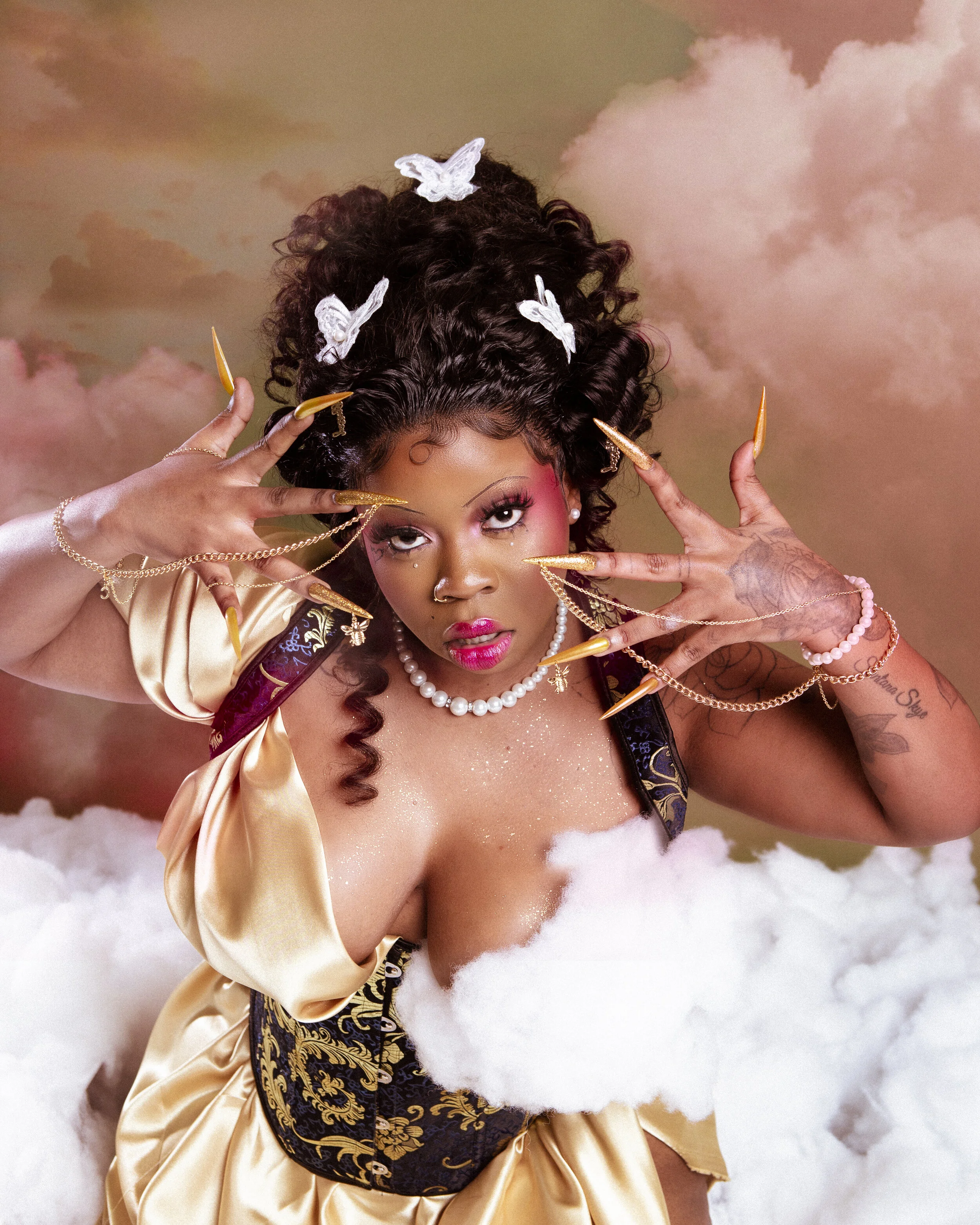
And in recent years we’ve seen some of the biggest Black women in rap dive directly into the world of fashion. From Cardi B’s wildly successful Reebok® x Cardi B Collection, to Megan Thee Stallion partnering with Fashion Nova for a clothing line and swimwear release and stunning as the face of Coach's recently announced BAPE Collection, to the City Girls linking up with Boohoo for a line of items, to the Saweetie x PrettyLittleThing collection that promised everything from “sexy street-style to show-stopping, figure-worshiping dresses that will take your IG to the next level,” the lines are plenty. It’s worth noting that the advent of “fast fashion” has allowed for the rapid and quick production of clothing in a way that was not seen in the early 2000s. To put it quite simply, fashion has changed a lot. Nonetheless, it does not diminish the impact, talent, and overall style Black women who rap bring to fashion. The demand is there and arguably, has always been.

Check out the five fashion lines from Black women rappers that you might have forgotten.

(Photos by Mychal Watts/WireImage)
(Photos by Mychal Watts/WireImage)

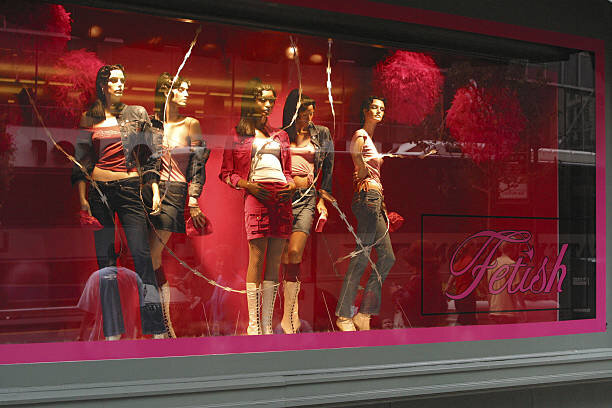
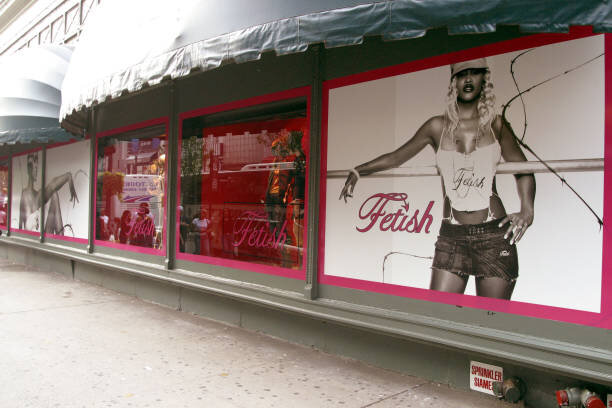
Fetish by Eve
In the fall of 2003, a little over a year after her GRAMMY win with Gwen Stefani for “Best Rap/Sung Collaboration” and in the midst of the first season of her eponymous UPN sitcom, Eve launched her clothing company Fetish. The line was sold in department store and included jeans, jackets, t-shirts, shorts, and handbags. The line shut down in 2009.

(Photo by KidduNot.com)

(Photo by KidduNot.com)

24/7 Star by Lil’ Kim
In 2011 Lil’ Kim debuted her clothing line 24/7 Star: The Goddess Collection at North Carolina’s Charlotte Fashion Week. She told NBC New York’s Niteside: “My inspiration is definitely all of my designer friends like Marc Jacobs and Donatello Versace. Those are my friends. I watched them prepare for shows, and I see [what] they [went] through.”

Screen Shot 2021-09-07 at 12.15.35 AM.png

Queen Collection by Queen Latifah for HSN
Rapper, actress, producer, singer, and songwriter-there’s literally nothing Queen Latifah can’t do. In August of 2011, she entered the fashion world with the launch of her Queen Collection exclusively for HSN, which featured everything from clothing and accessories to handbags and hair extensions.

Respect M.E. by Adidas Originals x Missy Elliott
Launched in 2005, Missy Elliott’s Respect M.E. line in collaboration with Adidas Originals boasted a long list of items, including sneakers, t-shirts, track jackets and pants, sweatshirts, leather jackets, boots, and accessories. It made perfect sense, as Elliott had been rocking Adidas for years before the launch of the line. When asked about Respect M.E. by WWD, Elliott said: “I feel really honored and excited to be doing this. I have been a fan of Adidas since Run-DMC.”

trina-pink-diamond-couture.jpg

Pink Diamond Couture by Trina
In 2008 Trina launched Pink Diamond Couture, a clothing line that included jeans with textures like leather, python, and crystals, embellished t-shirts, and two fragrances: Diamond Doll and Diamond Princess. On the line she said: “I have always imagined a clothing line that was high quality that I could offer to my fans. I spent a lot of time creating handpicked details that are fresh, unique and one of a kind. The best part they look really expensive but are reasonable priced.”
Cardi B’s Digital Dominance

by Brooklyn White-Grier

Cardi B’s “Bodak Yellow” has hit 1 billion views on YouTube.

We live in a time of random achievements holding weight in the digital realm. We celebrate 3-year anniversaries of albums and stats on video and streaming platforms. It’s different from parties for Grammy awards (though some major accomplishments, such as hitting 1B listens on Spotify do come with physical rewards), since they live online and are sometimes discovered by fans rather than institutions. They matter nonetheless and are marking how we think of music and the accolades that come with it. 

Cardi B’s first major single was a shocker to some, but not to analysts. We saw her charisma, knack for social media and sincerity when it came to making her own music. A brief stint on Love & Hip-Hop: New York helped her career as well, giving her additional name recognition. What I believe mattered most was Americans’ love for rags to riches tales and the thirst for relatability. 

Social media has lifted the veil in the sense that we’re often privy to the inner workings of celebrities’ lives. At best, we get glimpses into the creative process, selfies (or well-produced shoots that could be exclusive images for magazines), and teasers of new work. At worst, we get hateful rants and heavy doses of TMI. With Cardi, we got to see the most honest aspects of her journey and all of its twists and turns. So of course, her song about sex work, a Christian Louboutin glass slipper and a new smile performed well. We tend to thrive on the come up of others, running up their numbers in process. Because CDs are dead, right?

“Bodak Yellow” is a fun little doozy because it’s made waves in this new world of digital success and gotten thunderous applause in the old world, too. It was the first song by a woman in rap to top the Billboard Hot 100 since Lauryn Hill’s “Doo Wop (That Thing),” proving that we were indeed in new era for women. The girls with fake hair and acrylics became mouthpieces and no longer relied on others to tell their stories or rebuke them. Much had changed in nearly 20 years---a new wave of Black feminism emerged. Behold the new eHeroines who stand on the shoulders of the originators. 

Some of these awards from stan pages are bull, I think. Do we really care about XYZ being the first artist to release three songs this month? Should we really celebrate the 17th anniversary of a single? Maybe, maybe not. But times are changing fast. So we might as well be happy for every reason we can conjure up. 

Kali's Song "MMM MMM" Is A Summer Bop

maxresdefault-20.jpg

by Brooklyn White-Grier

Y’all know I ride for a poppin’ southern girl. So you can imagine my immediate interest in Kali, a 20-year-old rapper from Georgia whose single “MMM MMM” is a summer bop.

Read The Gumbo’s piece on how women from Texas are dominating rap music here. 

I spotted her through a Twitter repost from Houston’s KenTheMan. The two are close friends and have posted clips of them in the studio together, possibly when working on their joint song “Ain’t FWM.” 

Kali received major attention for “Do A Bitch,” which she first teased last June (the Twitter clip hit 1 million views, the music video 3.5 million) and released at the top of 2021. She then did something I thought was rather smart—she shared 3 different remixes of the song with guest verses from Rico Nasty, Enchanting and Saucy Santana, respectively. It’s always wise to capitalize on a music moment and fully gauge the success of a particular offering. 

"I'm just staying true to myself and I'm seeing that it's working,” Kali said to XXL in May 2021. “I just have faith in myself if I'm gonna keep doing what I'm doing and being me. It's working. Everything should work out the way I want it to." 

She’s also understandably adamant about not wanting to be compared to other women in rap, believing that artists are much more focused on making music than copying their peers. “I’m not going to the studio like, ‘I’m going to make a song like this girl,’...like, we’re not doing that,” she said during a 2021 conversation with Dirty Glove Bastard. It’s tough for women to dodge unnecessary juxtapositions with other artists, but maybe the first step is calling them out. 

Kali’s sole project on streaming services, “This Is Why They Mad Now,” dropped earlier this year and garnered a pretty positive response. Clocking in at just 17 minutes, it’s a bite-sized release that serves as a taste of the rapper’s skills and ear for production. 

Her most recent song is a viral joint that’s been making rounds TikTok, “MMM MMM.” Noting how the social media platform has helped turn understated tracks into Billboard-charting singles—Megan Thee Stallion’s Grammy-winning song “Savage” was an EP cut that went viral and inspired a dance challenge, while Erica Banks’ “Bussit” sparked a makeover series—it’ll be fun to track how to the song progresses. 

“Can I post you on my page? (Mmm mmm)/Spend the night at my place? (Mmm mmm)/Call a broke n---a bae? (Mmm mmm)/”He gone do just what I say (Mmm hmm),” she raps over minimalist, bass heavy production. It’s generally inspiring when women exercise their right to say no and outline the traits they’re looking for in a person, which takes the quotability of the song to the next level. 

With the ever-expanding landscape of women in rap swelling with fresh, innovative sounds and styles, Kali is staking her claim and letting us know how she gets down. Do we love it? Mmm hmm. 

Listen to “MMM MMM” by Kali below. 

Five Phenomenal Hip-Hop Feminist Must-Reads

by Kay Hollins

Through their work, Queen Latifah, Lauryn Hill, Mary J. Blige, and Missy Elliot, have been credited with bringing feminism into the male-dominated [and unfortunately, historically misogynistic industry that is Hip-Hop. The late 80s and 90s were a time when women in rap and R&B were blowing audiences away with empowering lyrics and style, and bringing Black feminism to the forefront through both. 

It was time for something new in Hip-Hop.  For once, we were getting music that not only sounded nuanced but also expressed themes like sexual liberation,  girl power, and the Black woman’s plight from the perspectives of those going through it all firsthand.

In 1999, Jamaican-American author and journalist, Joan Morgan’s classic, When Chickenheads Come Home to Roost: My Life as a Hip-Hop Feminist was published.  It is in this book that Morgan coins the term Hip-Hop Feminism, a sub-set of Black feminism that centers intersections of race, gender, and class while also acknowledging the contradiction of being a Black feminist that enjoys/is part of Hip-Hop music and culture.  Like Morgan, other amazing authors have been, in their own unique ways, defining and establishing the political, economic, personal, and social equality of the sexesSo, here are five texts that every Hip-Hop feminist should read; and why! 

51wDTWF8zWL._SX325_BO1,204,203,200_.jpg

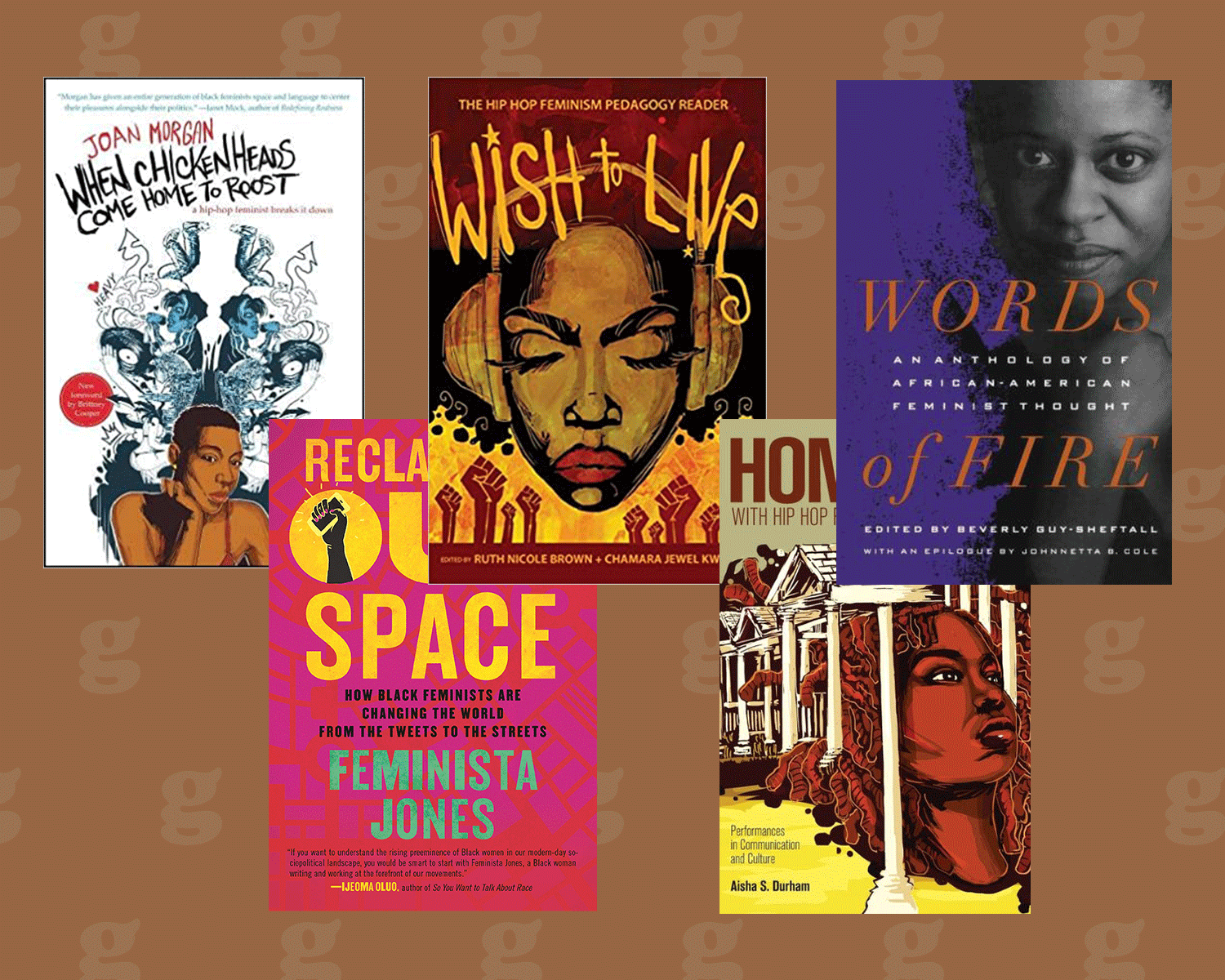
1. When Chickenheads Come Home to Roost: My Life as a Hip-Hop Feminist by Joan Morgan, 1999

For the Hip-Hop feminist reader, Morgan’s Chickenheads is a powerfully potent read via the lens of a Black woman that loves Hip-Hop, though she often feels it does not love her back.  This book is just as vibrant and creative as it is academically innovative and educational, as it presents and analyzes information crucial to both community and culture; flavored like the experiences our mamas tell us about.  It’s amazing how many topics and issues surrounding Black womanhood (sex, sexism/racism, dating/courtship, motherhood, careers, etc.) that Morgan mentions remain relevant two whole decades later.  Her diction is funky, conversational, hip and entertaining .  Just as much of a must-read now as it was in ’99!

817rRobhClL.jpg

2. Reclaiming Our Space: How Black Feminists Are Changing the World from the Tweets to the Streets by Feminista Jones, 2019

Feminista Jones is an American social worker, activist, cultural commentator and writer.  Along with contributing to The Washington Post, Salon, TIME, and Ebony, she has received great acclaim for her threads on Twitter and her decades-spanning work as a blogger.

Jones’ book, Reclaiming Our Space, analyzes how feminism has changed over the years because of the technological advancements of the internet, specifically social media.  Though focusing on feminism rather than Hip-Hop feminism, this is a great read because it focuses on the differences between feminism and Black feminism.  It emphasizes that Black [feminist] women have quite the different experience in the fight for equality than our white counterparts, due to also having to face sexism and racism (various forms of misogynoir).  This book is full of research, and knowledge dating back to slavery, as Feminista Jones makes connections to the work modern Black feminists are doing today.

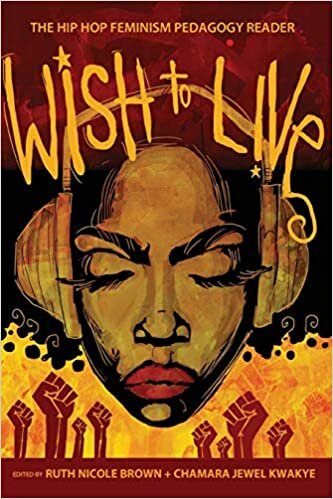
3. Wish to Live: The Hip-Hop Feminism Pedagogy Reader by Ruth Nicole Brown and Chamara Jewel Kwakye, 2012

Assistant professor of gender and women's studies at the University of Illinois at Urbana-Champaign, Ruth Nicole Brown and scholar, Chamara Jewel Kwakye implement poetry, performance, document analysis, playwriting, polemics, cultural critique, and autobiography into this compilation of Hip-Hop feminist theory.  Wish to Live is the analysis of the radicalism of Hip-Hop, with its history of expressing the realities of social issues in the communities that have been credited with its invention and advancement.  Moving beyond, yet still influenced by, the elements of Hip-Hop (rapping, breakdancing, graffiti art, and deejaying), collections such as this one are great when searching for those doing the work to expose injustices that Black women face in a way that is modern, and also encourages the youth to get involved in community activism.  

9781433107085_p0_v14_s1200x630.jpg

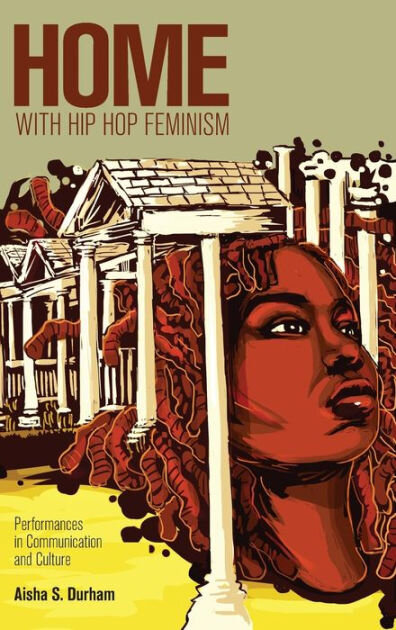
4. Home with Hip Hop Feminism: Performances in Communication and Culture by Aisha S. Durham, 2014

From a Hip-Hop feminist perspective, Aisha S. Durham, cultural critic and Assistant Professor of Communication at the University of South Florida analyzes the correlation between white-centered feminism and masculinist Hip-Hop culture.  As a lover of Hip-Hop, similar to other authors in this list, Durham asks the important question: where do Black [feminist] women fit into the culture?  This is a read that celebrates Black womanhood in the ever-evolving pop culture world, which as we know is heavily influenced by Black and Hip-Hop culture alike.  This read excellently includes everyday experiences in such a real and raw way, appealing to undergraduate and graduate students interested in media and cultural studies, race and ethnic studies, and gender and sexuality studies; but also those of us looking for something relatable and insightful.  

lf.jpeg

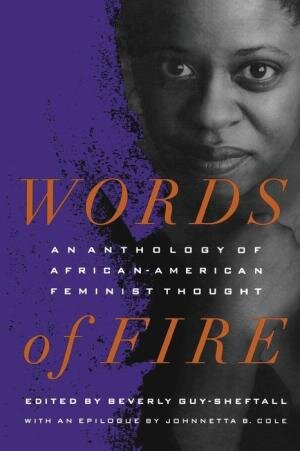
5. Words of Fire: An Anthology of African-American Feminist Thought by Beverly Guy-Sheftall, 1995

Beverly Guy-Sheftall, Black feminist scholar, writer and editor did something so masterful with Words of Fire.  In this collection we are gifted with contributions from over sixty prolific Black women, including feminist greats Shirley Chisholm, Angela Davis, bell hooks, June Jordan, and Alice Walker.  Credited as the first major anthology to trace the development of Black Feminist thought in the United States, Words of Fire privileges us the wisdom of our ancestors and feminist predecessors from their perspectives; views of the fight for equality, dating all the way back to the earliest days of abolition and the planning to dismantle the master’s house.  To know our history is to know ourselves, and it is so beautifully fulfilling to know that when it comes to feminism, particularly Black feminism, the fire to dismantle oppressive systems is generational and inside us all.  

*Happy reading, and cheers to a Hip-Hop loving, hot girl summer! 

Reflecting on the Hip-Hop Feminist Lyrics of Amil’s “I Got That”

by Nadirah Simmons

Any mention of Amil ignites a fire under me that’s reserved for only a handful of other Hip-Hop acts. If you’re following the right people on social media, you’re bound to come across the widely shared meme of her from Backstage, in which Dame Dash proclaims “she’s ghetto, but she has a runway quality about her. And if you shuffle Jay-Z’s discography on your favorite DSP you’ll hear her spitting verses on some of his and the Roc’s biggest hits, like “Can I Get A…,” “N*gga What, N*gga Who (Originator 99)” and “Do It Again (Put Ya Hands Up).” However there’s one song that exists in Amil’s catalogue that stands out as one of my favorites by affirming my position as a Hip-Hop feminist and providing an anthem for women empowerment: “I Got That.”

“I Got That” is the second single from Amil’s debut studio album All Money Is Legal (A. M. I. L.), and is the first single on which Beyoncé performs solo without the other members of Destiny’s Child. Amil opens the song by rapping: 

Plus, I got my own bread
You ain't gotta wave dinner over my head
I got that
And you can't leave me stranded
'Cause I got a ride back, and besides that
What chick you know got cock, Glocks back?

In ‘Using [Living Hip-Hop] Feminism: Redefining an Answer (to) Rap’ by Aisha Durham, she draws from the work of Joan Morgan-who coined the term Hip-Hop feminist-and contends that the philosophy is a “cultural, intellectual, and political movement grounded in the situated knowledge of women of color from the post civil-rights or Hip-Hop generation who recognize culture as a pivotal site for political intervention to challenge, resist, and mobilize collectives to dismantle systems of exploitation.”

Amil positions herself as an autonomous woman who can get it on her own and challenges sexist narratives that often appear in the lyrics of men who rap that depict women as reliant on them for success. What’s important to note as well, is that Amil doesn’t shame women who want the opposite. And in Hip-Hop feminism it’s important to acknowledge the philosophy as one that allows Black women to support feminist agendas while also employing different modes of expression within the genre. 

On the second verse Amil acknowledges her position in the rap game might invite in men who are interested in being with her sexually, saying “Ever since cats found out I ran with the Roc/They wanna take a closer look, wanna examine the box…The way I be dressin', dudes wanna toss the salad.” On the song Amil uses her lyrics to challenge hegemonic masculinity, explicitly highlighting sexual acts and challenging patriarchal scripts that exist to dictate what women can or cannot say about sex.

It is this kind of Hip-Hop feminist critique described by Marlo David in her essay, “More than Baby Mamas: Black Mothers and Hip-Hop Feminism,” that provides Amil and other women who rap with a “way out of the mire of postmodern detachment to invite women and men to get down to the business of bringing wreck against the social forces that control their lives.” 

This control is clear in the video as well, with Amil, Beyoncé, and Eve-who makes a cameo-gliding from scene to scene and spending time in the office, in the store, behind the wheel of expensive cars, and at the club. If the lyrics weren’t enough, watching the visuals makes it clear that the ladies “got that” forreal.

Amil exited the rap game after the release of her debut and only album, citing her disdain for the spotlight and entertainment industry as the reasons behind her departure. In 2011 she told Vibe Magazine:

“I’m happy for the time that I had, but [the entertainment industry] is not for me. I enjoy recording, thats always a passion, but as far as going hard with a recording career… at this point no. I’m an old head. My whole life is so different now. But I’m in a beautiful place and really just enjoying myself.”

Wherever Amil is at right now, it’s important that she knows “I Got That” deserves to sit alongside tracks like “U.N.I.T.Y.,” “Let’s Talk About Sex,” and “Ladies First” in the canon of Hip-Hop feminist anthems. It’s a song that asserts her right to pleasure and financial independence as a Black woman, and knocks down the walls that uphold systems of oppression involving race, class, sexuality, and gender. It’s self-expressive. It’s honest. And it’s enjoyable. It’s Hip-Hop feminism at its core.

Eve And Trina's Verzuz Reminded Us How Necessary Women Are To Hip-Hop

verzuz-eve-vs-trina-640x360top.jpg

by Brooklyn R. White

On June 16, Verzuz, the battle that began as a head-to-head for the most groundbreaking producers in Black popular music, welcomed two titans--Ruff Ryders’ first lady, Eve, and Miami-based Billboard chart-topper Trina. Both icons, who catapulted in the late 1990s, took to the stage and reminded fans why they fell in love with their signature styles. Indirectly, it was an indicator of all that women have contributed to rap music. 

Who’s that girl? E-v-e, the self-proclaimed pitbull in a skirt. The only woman Hip-Hop artist who ran with Swizz Beatzs and DMX and one of the most multifaceted stars of the millenium. (I mean, who else, other than Queen Latifah, has the capacity to meander from rap, to sitcoms, to films, to a daytime talk show? I’ll wait.) In her earliest work, she was tied to the happenings of the inner city, showcasing the sometimes bleak realities in her music, but acknowledging the sunnier moments as well. Her first two projects, collectively containing songs like the Grammy-winning crossover joint, “Blow Ya Mind” and the poetically weighty “Love Is Blind,” ascended the Billboard Top 200 Albums list, with her first making her only the third woman in rap history to do so. Her later singles and guest appearances were just as red hot, too. If you haven’t heard her opening and closing bars on Amerie’s “One Thing,” you’re sleeping. 

Her Verzuz opponent wasn’t really a rival---Eve and Trina refer to each other as “sister” and have worked together in years past. So the jolting tension of say, Gucci Mane and Jeezy’s battle, was not present. The two women released their debut albums, Da Baddest Bitch and Let There Be Eve… roughly six months apart but they vastly differed in content. Trina emerged guns blazing, following in the tradition of Lil’ Kim and Foxy Brown and generating spoken raunchfests. With memorable quotables (“I'm representing for the bitches/All eyes on your riches/No time for the little d----”), she helped make space for a new generation of fully empowered, cheeky women who knew the impact of their words. 

Trina brought a distinctness to the table though, her accent, tone, and delivery made her roots unmistakable. Like, “Nann Nigga,” as a phrase is deeply meridional. It was indicative of the way she would mandatorily present herself moving forward. With six albums to her credit, and a handful of mixtapes and EPs, she is certainly one of the most consistent figures in rap, possibly a suitable rival for Juicy J in that regard. Like him, she has also embraced the artists who follow her, as she was an early supporter of the City Girls. Trina is the connective tissue to the women who preceded her, too. 

This most recent Verzuz marked the first time two women rappers were up against one other. The previous women included were soul singers and the other rap battles had been reserved for men. More of these kinds of matches are certainly needed, just to simply honor the rich legacy and continued artistic relevance we have. We were and have been present since Hip-Hop’s beginning, please make no mistake about it. We wrapped fingers covered in gold rings around microphones and battled with the best of them (no, seriously---Roxanne Shante was slated to be crowned the best freestyle rapper in the world but was sabotaged because of her gender). Women highlight rap’s tendency to be casually misogynistic in speech and other glaring issues existent within the genre. Our balance, insight, and outlooks prevent Hip-Hop from losing dimension.

There is no Hip-Hop without women. But you knew that though. Watching Eve and Trina run through their hits was a treat, but furthermore evidence that women have held their own. Even when being backed by a man was a prevalent entry point into the music industry, it was up to us to maintain momentum and it’s clear that we did. So when you’re writing your books, engaging in hot takes on Twitter and creating those ridiculous lists of the 50 greatest rappers of all time, remember the women who gave Hip-Hop its flavor.

And while I have you, let’s start the campaign for Missy Elliott to have her own Verzuz.


La La Anthony: Solidifying Power and Loyalty

image-3.jpeg

By Kimberly Denise Williams

In real life and on television, La La Anthony is known for her loyalty, fealty, and being best friends with some of the biggest names in the industry. Her most popular acting role to date, playing Lakeisha Grant on Power, was the loyal friend to the lead character, Tasha St. Patrick. Online, Anthony is often seen with her besties, a rotating group of other high profile women. In many of her upcoming roles, Anthony is poised to star as even more strong, powerful characters. And with over twenty years in the entertainment game as a DJ, personality, producer, author, clothing designer, and actress, the Hip-Hop veteran has proved that same devotion is the key to long standing success. 

Born Alani Vasquez in Brooklyn, NY La La identifies as Afro-Latina with Black and Puerto Rican roots. If you read  and watch any of her interviews you’ll see that Anthony represents New York to the fullest, and speaks of the city with the adoration native New Yorkers are known to bestow on their home. While a high school student in Atlanta, she interned and hosted her own radio show Future Flavaz alongside Ludacris. From there, her career grew. She attended the legendary Howard University in Washington D.C., where she was a DJ for the campus station. She held a few more radio jobs, before her career defining role as an MTV VJ. In a 2020 interview with Essence Magazine, she said that’s how many people still identify her “Oh that’s La La from MTV.”

On Direct Effect, an MTV countdown show of the top five most requested rap and R&B videos, La La showcased her skills interacting with both the audience and high wattage entertainment celebrities, conducting interviews about their lives, career trajectories, and current projects. On TRL, La La served as a VJ, playing the ten most requested music videos of the day and interviewing both artists and actors along the way. As a host on both shows, La La would go on to interview some of the biggest names in music including JAY-Z and Beyonce, and actors and actresses like Will Smith, Brad Pitt, Tom Cruise and Angelina Jolie.

Her talent as an interviewer was undeniable, influencing the development of Direct Effect Presents: Fashionably Loud, where La La hosted alongside model Molly Sims and highlighted the latest in fashion and music, possibly foreshadowing her own career turn in the fashion industry as the designer of her own clothing line, which debuted at Lord and Taylor. Her versatility and commitment to hard work didn’t stop there, with La La going on to host more shows and specials like MTV’s Spring Break, and even helming her own reality shows with La La’s Full Court Wedding and La La’s Full Court Life

That twenty something La La Vasquez from MTV is now power icon, Alani ‘La La’ Anthony who is committed to pursuing her passion, acting. Her role on Power is only part of her acting resume, with roles in a wide cross section of projects from silver screen hit Act Like a Woman, Think Like a Man and the sequel, sweet family movie Holiday Rush, BH90210- part of the Beverly Hills Franchise, SHOWTIME original series The Chi, to voice acting for the animated show The Freak Brothers. She’s also set to star in the upcoming show Black Mafia Family, as well as play legendary Def Jam executive Tracey Waples in Wu Tang: An American Saga.

The work doesn’t stop off the screen either. She’s acted in Off Broadway plays and co-produced Danai Gurira’s acclaimed Broadway show “Eclipsed.” She’s adept at using various media formats to push issues and ideas that affect large groups.  As an Afro-Latina, she has consistently advocated for her people. She’s appeared on magazine covers for both Latina magazine and Essence, highlighting her place as a woman at the intersection of both communities. She’s partnered with Special K several times on health initiatives, and this summer she is working with the cereal brand to encourage women to run in conjunction with the national running group Black Girls Run. She has also consistently advocated for her people and celebrated the Afrolatinidad, appearing on magazine covers for both Latina magazine and Essence and highlighting her place as a woman at the intersection of both the Black and Latin communities.  

There’s a lot more in the works, and in conjunction with several heavy hitters. JuJu, a horror comedy described as “Mean Girls meets The Craft,” will focus on the struggles high school students face and is being worked on in collaboration with Issa Rae, The Shade Room’s Angelica Nwadu, and Thembi Banks. She is also working with longtime friend and collaborator 50 Cent on a limited tv series on the Cyntoia Brown Long story. She’ll play a role in the Netflix  adaptation of Tia Williams’ The Perfect Find alongside Gabrielle Union, Aisha Hinds, and Janet Hubert. 

No matter which medium she’s making moves in, Anthony is a Hip-Hop veteran who continues to put on for the culture everywhere onstage, on the screen, and on the page-and yes in all her bff’s Instagram stories too. 


Is Image Everything?: on the Photos Complimenting Pop Culture's Biggest Moments

by Brooklyn R. White

Picture this. The City Girls, heirs apparent to Salt-N-Pepa (though more lyrically aligned with Lil’ Kim and Foxy Brown’s would-be duo), bent at the waist, peering back through gapped legs, ready to twerkulate. Their bodies draped in a form fitting, black leather and sheer combo, feet elevated by glass heels. The ladies’ hands are accented by multi-inch, hot pink acrylics and are gripping their butts, thighs, the back of their knees and their ankles (thanks to Photoshop, of course). The sex appeal trancends states of matter---it’s powerful enough to fill the air and drip down to the floor at the same time.

Though the “Twerkulator” art is a home run, it follows a classic formula. Over the past 40 years, Black women’s album covers, single art and posters have shocked and satisfied fans, attaching an instantly recognizable image to music. 

IMG_0233.jpeg

The art for “Twerkulator.”

Millie Jackson is the mother of women in rap, making it fitting that her artwork be just as riotous as covers of the women who were inspired by her. Jackson began performing in the 1970s as a soul and country artist, stumbling into a career after being dared by friends to hit the stage. She didn’t have any technical training, but she made some more than solid cuts (her “If Loving You Is Wrong) I Don’t Want to be Right” cover is the biggest), and drew attention for her bawdy interludes and album artwork. Some of her more memorable images include 1983’s Extra Sexual Persuasion, which featured her with red nails, waved hair and a crystal ball that highlighted her breasts, and Back to the S--t! 1989’s Back to... showed her sitting on a toilet with her panties pulled down.

Jackson ruled during the day of vinyl. Back when a hot cover was enough to catch someone’s eye and sway them into purchasing your music. Though her no holds barred music did rock and was indeed a direct predecessor to rap, her cover art set her apart. You knew what you were getting into from the visual alone.

Millie Jackson’s Extra Sexual Pleasure cover art. Shot by Chuck Stewart. 

Millie Jackson’s Extra Sexual Pleasure cover art. Shot by Chuck Stewart. 

Back to the S--t!, 1989.

Back to the S--t!, 1989.

We inhibit a world that emphasizes what can be seen. This is why songs skyrocket when TikTok challenges are introduced and more anciently, why there was a connection between cave paintings and shamen. The appeal of Instagram relies on people’s deep connection to images. Other social platforms are not too far off either—dating sites encourage users to share photos of themselves, archival Instagram accounts are solely dedicated to stills from notable Black films and Facebook teems with screenshots of written posts that have been turned into more alluring graphics. We are drawn to the fueling of our imagination, or at least we think we are. 

“Sometimes viewers don't know what's creative, and that can have an effect on the talent you're with and that can push you into a tiny bubble,” said Marcelo Cantu to PAPER Magazine in 2017. Cantu is the photographer behind “Twerkulator,” Cardi B and Megan Thee Stallion’s “WAP,” and Megan’s Good News. “But on the other hand, you have so many artists who have been able to navigate amazingly.”

Megan Thee Stallion’s cover art for Good News. 2020. 

Megan Thee Stallion’s cover art for Good News. 2020. 

On navigation, another raunchy sista, Lil’ Kim, broke societal barriers with a single poster shot by Michael Lavine. During a 2019 appearance on an Uproxx podcast, the rapper reminisced on the image chosen for the promotional art for her 1996 Hardcore album, calling the portrayal “cute” and “classy,” as she mulled over the oft-imitated squat pose, Patricia Field bikini with a  matching duster and her knowing gaze. Kim said she initiated feminist calls to action, vicious prison fights, and verbal attacks from activists, all because of the artwork. The impact was bigger than she could have imagined—the pose has been recreated by some of the most-discussed figures in popular culture, including Beyoncé, Kim Kardashian and Nicki Minaj. The album is now double platinum, 25 years after its release. 

Read our celebration of Lil Kim’s career here. 

Lil’ Kim’s Hardcore insert poster. 

Lil’ Kim’s Hardcore insert poster. 

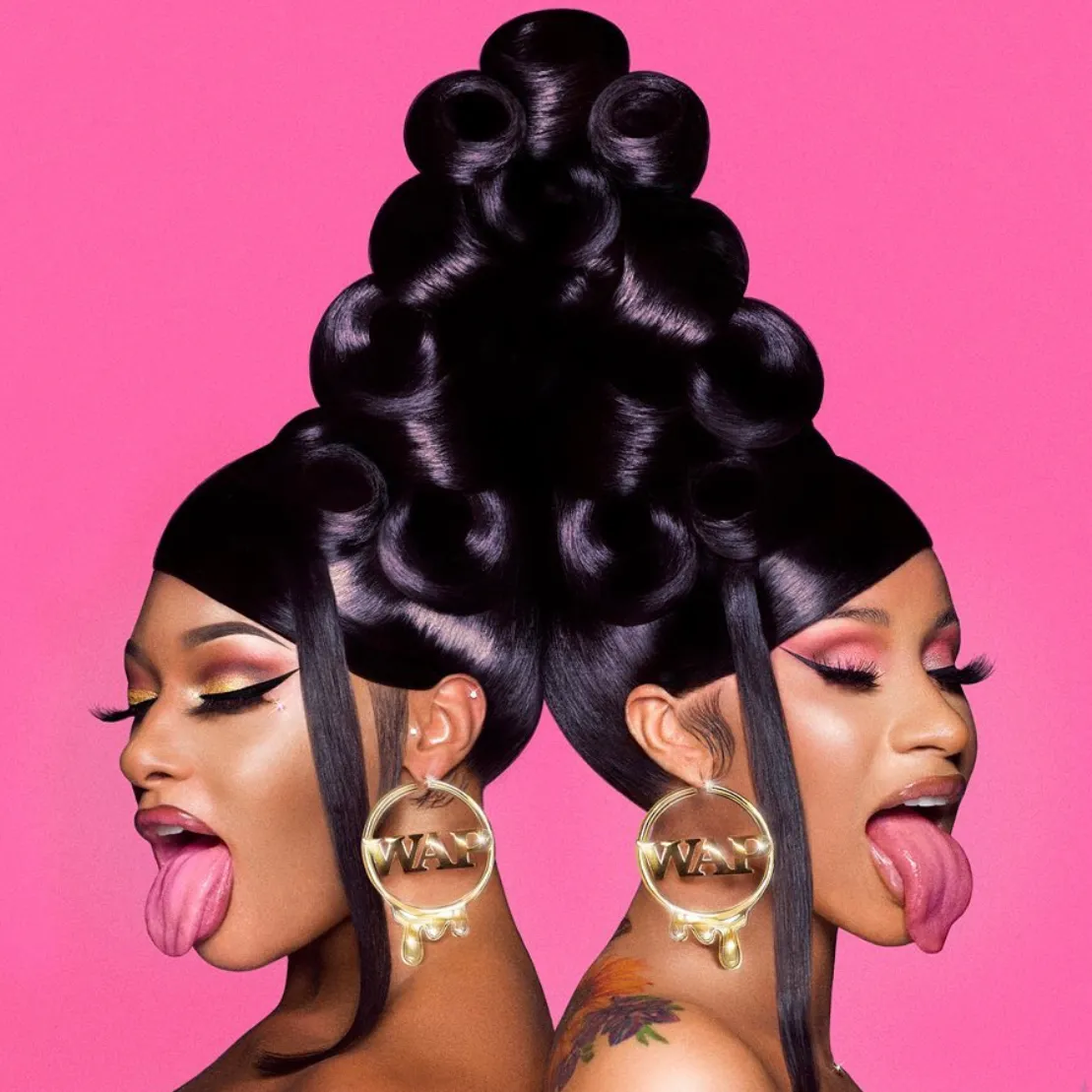
The single art for “WAP” was just as much of a head turner as it’s sister photo, “Twerkulator,”  but it had a bit different purpose. For the shot, Megan Thee Stallion and Cardi B faced away from each other with stacked updos and their tongues seductively hanging out. The artists’ nails peeked into the frame as they cupped their breasts. Unlike with the City Girls’ art this was all we had until we heard the single in full. Truthfully, the controversial song and video content far outweighed any discussion about the image, but it was enough to inspire a beauty trend and restart conversations about the innovations of Black beauty methods. In the beginning though, the meaning of “WAP” was a true mystery and we relied on the art for hints. It will stand the test of time because it plays into our love for nostalgia and a retroactive passion for the vulgar. 

The cover art for “WAP.”

The cover art for “WAP.”

Like music, art is simply expression. Historically, Black women’s most honest expression has been heavily filtered due to the intersection of our womanhood and Blackness. We’re ridiculed for sexual openness, though in reality, we are blueprints of feminism, embodying the scholastic without consideration. The images synched with our music are classic upon release because they are sometimes exactly everything we’re vilified for—raw, hot and in-your-face. What a beautiful resistance. 

How Kelis Gave Us A Glimpse Into A New World with 'Kaleidoscope'

Kelis photographed by Jonathan Mannion (1999)

Kelis photographed by Jonathan Mannion (1999)

by Gina Physic

On her debut album, the “Caught Out There” singer blended hip-hop and R&B, among other genres.

In the moments before the turn of the century, Kelis burst into the industry screaming, quite literally. In her debut single “Caught Out There,” from the studio album, Kaleidoscope, Kelis was herself, unafraid and ready to meld genres in a frantic time that desperately needed new energy. With her single, and the album as a whole, Kelis repackaged sounds familiar to hip-hop, R&B, rock, and funk, forever transforming the former two.

While Ol’ Dirty Bastard’s “Got Your Money” is one of Kelis’ best known hooks (the track samples “Cold Blooded” by Rick James), it, nor “Caught Out There,” was her first step into the music industry. After graduating high school, Kelis was featured on “Fairytalez” by horrorcore rap group Gravediggaz. But even before this, the singer played violin, saxophone, sang in the Girls Choir of Harlem, and grew up with a musician father. She often would share that she found inspiration in everything---and it was this love, plus past experiences with music, that made Kaleidoscope as impactful as it was. 

During a 2021 Sundance Film Festival panel on speculative fiction, the self-proclaimed “foremother of Afrofuturism”, Jewelle Gomez, stated, “For us, the past is more than prologue. The past is a really deep stew that we are cooking in and we cannot go anywhere without the aroma of that past.” The same was true of the sound Kelis introduced as a signee of Virgin Records, which was also the home to other genre-blending Black performers like Janet Jackson and Aaliyah. She was unlike anything hip-hop or R&B had seen before---experimental, while leaning on some of the very sounds that helped to birth both hip-hop and R&B: jazz, gospel and disco. With the help of The Neptunes, who fully produced Kaleidoscope, she was able to forge a new sound that remained in conversation with the sounds of the past.

Songs like “Ghetto Children” (the first track N.E.R.D appeared on) offered a futuristic and playful take on 80s rapper Slick Rick’s “Hey Young World” while laced with Kelis’ effortless, honey-dipped vocals. With “Roller Rink,” she took listeners bouncing on a psychedelic ride through space over a sample of Al Jarreau’s “No Ordinary Romance.” Kelis was repackaging an existing musical lexicon to formulate her sound, and as a result, bridging the worlds of hip-hop and R&B. 

Shortly after Kaleidoscope was released, Kelis completed a promotional stop on the BBC’s Later… with Jools Holland, a show she frequented since her work was received warmly in the United Kingdom. In the 2000 interview, she explained why she called her album Kaleidoscope, saying “Well, I mean, just think about what a kaleidoscope is. It’s a really great blend of many different things and together they’re each individual pieces, but when you put them all in one… it’s a big picture.”  During the interview, Holland also noted a conversation he had with Kelis’ band, sharing that they were heavily influenced by Willie “The Lion” Smith, a jazz and stride pianist who was a predecessor of composer and bandleader Duke Ellington. The band was also inspired by James P. Johnson, “The Father of Stride Piano,” and Jelly Roll Morton, who is widely recognized for aiding in the evolution of ragtime into jazz. 

Jazz, with its reliance on improvisation and sample-ready percussion, lent its back to the building of hip-hop, directly playing a role in the sonic territory Kelis explored. 

Beyond Kaleidoscope, when Kelis toed the line between hip-hop and R&B, she was part of some of the most influential collaborations across the genres, establishing a formula that would dominate radio waves and later, streaming platforms.There was a time, as she recalls, that she was a “feature girl on every hook there was.” From her offerings with Foxy Brown, to Angie Martinez, to Busta Rhymes to her former labelmates, The Clipse – Kelis left her mark. Her music has since been sampled by James Blake, Xzibit, The Internet, Disclosure, and when it isn’t directly sampled, it’s referenced heavily

Much like the lineage from which Kaleidoscope pulled, Kelis’ own influence is sprawling. Her early musical contributions bridged a gap between hip-hop and R&B, encouraging change and inspiring a generation of music makers. But of course they did, since she came in the game telling us that the good stuff was right here. 

LaToiya Williams’ Undeniable Star Power

by Nadirah Simmons

A quick Google search on the relationship between Hip-Hop and R&B will affirm that it is a tight one, from the inception of new genres like New Jack Swing and Hip-Hop Soul to the increased presence of Hip-Hop and R&B collaborations. And anyone who is a fan of Hip-Hop knows the right collaboration can take a song from good to great. Enter Los Angeles-based songstress LaToiya Williams, whose unique voice and work with heavyweights like Snoop Dogg, JAY-Z and Busta Rhymes cements her as a Hip-Hop staple.

Originally a Gospel singer, LaToiya found herself singing background for Gladys Knight and Yolanda Adams before meeting Snoop Dogg. She appeared on his 2002 compilation album ‘Doggy Style Allstars Vol. 1,’ an offering that included the standout track “Fallen Star.” On it LaToiya lamented the broken promises of a lover.

“You promised me Saturn, Venus and Mars/But all I got was bullshit and a fallen star (Fallen Star)/Out of this world, galaxy so far (So far)/Constellation tells me it's not from the heart,” sang LaToiya over a G-funk beat. In combination with lyrics rooted in Soul and R&B tradition, Williams masterfully delivered a ballad on love and heartbreak that encouraged a two-step and self-reflection at the same time. The accompanying video-just one of two shot for the album-paid homage to the 70s and Soul music of the past with a set reminiscent of Soul Train.

She would go on to lend her vocals to JAY-Z’s “All Around The World” from ‘The Blueprint 2,’ Anthony Hamilton’s “My First Love,” Young Buck’s “U Ain’t Goin Nowhere,” and the soundtracks for movies like “Baby Boy” and “Soul Plane.” In 2018 Williams released her first full full-length album ‘Blue Rose,’ a project she described as therapeutic:

“[It] starts off as we’re a happy couple. We’re doing well and then in the middle of the CD, it changes. I find out that he has a wife somewhere. I find out that he has a family. That’s where the Blue Rose comes in. That’s where the sadness the color blue comes from, that pain of me finding out the guy that I’m with is actually married to someone. Every single last song is true to life and it’s true to my life. Literally, this ‘Blue Rose’ album is a book about me and my feelings and what I been through in the last 10 years without being signed to Snoop Dogg and the stuff I’ve gone through with my man. So, it’s all true.”

The truth, honesty and authenticity in LaToiya’s voice guarantees that any song she is on will hit you right in your soul. So whenever we talk about Hip-Hop and R&B collaborations, LaToiya must be in the conversation. Her voice was the glue that pieced together cuts by the biggest rappers in music.

The Joi of Freedom

Source: alljoieverything.com

Source: alljoieverything.com

by Brooklyn White

Joi Gilliam is a conscious rock star. Unbound to the beaten road of pop’s trendsetters (constantly producing content and publicized struggles with sonic evolution/personal growth), she’s walked tall during her 25+ years in the music industry and shows no signs of slowing. “I get excited to pull the machete out and clear my own path,” she says in her official bio. “After all of these years, music is still a lifeline to sanity, memory, and inspiration for me. It’s the most powerful medium, for better or worse. I hope you feel what I’m doing.” Not only is Joi deeply felt, she is admired by many and her album ‘The Pendulum Vibe’ proves she is a staple in avant garde soul focused on liberation.

The singer/songwriter is a proud Tennessee native, which is made apparent by her use of the alias “Tennessee Slim Kitty.” After leaving Tennessee State University and moving to the everlasting musical-hotbed of Atlanta in the early 1990s, she crossed paths with Dallas Austin, the producer/songwriter famous for his work with TLC, Boyz II Men and Macy Gray. Together they crafted Gilliam’s 1994 debut, ‘The Pendulum Vibe,’ a cult classic adored for its feminist themes, over the course of three weeks.

“She is the truth and the most famous person I know,” -André 3000

Black feminism, particularly sexual liberation, equality and freedom from archaic ideas of womanhood, have been further explored by newer singers like Teyana Taylor, Jazmine Sullivan and Ari Lennox, with the former’s emphasis on maintaining personhood while raising a family echoing Gilliam’s. But at the time of Gilliam’s ascent, mainstream R&B was still very much married to the blues (and truthfully, cash) and while that can be looked at through a feminist lens of its own, the one used to observe Gilliam was rather limited. After issuing her debut, she was implored to be more like R&B’s biggest commercial successes, but thankfully, she pushed back and continued to allow her sense of self to guide her.

Source: alljoieverything.com

Source: alljoieverything.com

On ‘The Pendulum Vibe’s’ “Freedom,” she spoke specifically about the oppression that Black women face.

“You thought that I would never wise up/And I showed you what a Black female can do her thang/You cannot continue to keep me oppressed/'Cause I ain't goin' out like that,” she sang over the jazz-inspired cut with canned vocals. Less than a year after the song’s release, it was re-recorded for the Panther soundtrack and featured over 60 Black women in music, including Aaliyah, TLC, Mary J. Blige and SWV.

Gilliam delved into sexuality in her song “Narcissa Cutie Pie,” a loud and proud anthem about bisexuality. “I tantalize, I mesmerize, I can do whatever I want to...The other side is calling and I want to go with you,” she sings, referencing a potential sensual encounter with a woman. At the time, popular songs about queerness from Black artists were not overwhelmingly common, further setting Gilliam apart and helping her carve out her own lane as an artist and a sensual being. Decades after the song’s release, you’re much more likely to hear Black women explore their sexuality on record (Victoria Monét, Janelle Monae). 

With her debut, Gilliam showed posterity how to address the worst of society’s conditioning without coming off as contrived or preachy, which tend to have serious overlap. Though she’s underground, Gilliam is the “most famous person” Andre 3000 knows, she was tapped to assist D’Angelo on his most recent tour and has even inspired Madonna. Her honesty remains refreshing, her freedom is well deserved.

A Requiem for Party Spaces of My Past

IMG_30BAD55B7E42-1.jpeg

by Summer Jones-Oden

I love a good party. You know the ones where EVERYONE is dancing and singing out loud? Maybe a couch stand or two? No pretentious bottle service or restrictive dress codes, just a good old-fashioned party. 

I haven't seen or heard music outside of my house or in a car in over a year. No concerts, lounges, bars, parties or functions with a DJ. I never thought I’d ever type those words-much less say them out loud-as Hip-Hop has been my source of joy for as long as I can remember. I have a very personal connection to a few spaces where I always felt safe and seen as a Black woman who loves the fellowship that music brings. So when I started jotting down notes to prepare this piece, memories of the Summer of 1994 came rushing back. 

At that time I was preparing for my senior year of high school while working a part-time job ridiculously optimistic about the next phase of my life. A chance meeting with a coworker’s daughter would change everything. Enter Club Fever in Philadelphia, Pennsylvania. 

IMG_1944.jpeg

“The Underground at Club Fever” was the 18 to enter, 21 to drink Friday and Saturday night Hip-Hop, Reggae and R&B party presented by the legendary DJ Storm. My friends and I would usually arrive around 10pm to stand in unbelievably long lines to enter the basement-level space. Upon entering we’d be shoulder to shoulder with friends from all across the tri-state area, and the energy truly encapsulated what it meant to enjoy Hip-Hop in the early 90s, when the genre had started to take on a life of its own. DJ Storm kept the crowd engaged and rocking with everything from Black Moon to Buju Banton. Ciphers would go on by the bathrooms. Dance battles would break out in the middle of the club frequently throughout the night-the kids from Philly would always win.

Club Fever began to book Hip-Hop shows that hosted artists like Da Youngstas, Mobb Deep, members of the Wu-Tang Clan, The Boot Camp Clik and an infamous New Year’s Eve show that featured the Notorious B.I.G and a newly signed group that he formed and mentored, Junior Mafia. The security was friendly but tight, much like that one uncle you knew not to test. There were never any fights, with small skirmishes being quickly de-escalated so the party could continue. And continue it did, until it was time to go home and drag ourselves up that stairwell and do it all over again next weekend. 

In the summer of 1998 I turned 21 years old and was now freed from the shackles of the obviously fraudulent ID card that I had been flashing at the door up and down what was then called Delaware Avenue. Today the location goes by the name Columbus Boulevard, home to the Penn’s Landing waterfront area and many restaurants, bars, clubs, parks and the pier.

IMG_2032.jpg

The clubs that lined the aforementioned pier put Hip-Hop at the forefront each and every weekend. A personal favorite spot of mine, especially during Greek Picnic Weekend, was Bahama Bay, a tropical tiki bar-themed indoor and outdoor space where DJ Kool would film the video for the classic “Let Me Clear My Throat.” Just down the street was Vegas, a mildly upscale Las Vegas-themed club that hosted some of Philly’s most notable NBA and NFL players. Just across the street was the grittier Gotham Nightclub, a converted warehouse with impeccable acoustics. The opportunities for partying were endless, and at the age of 21 I had the freedom to go wherever I wanted to without breaking into a cold sweat at the door as the bouncer looked back and forth from me to my fake ID.

My newfound freedom also found me in New York City, traveling there most weekends with friends and making it back to Jersey by Monday morning. One particular weekend provided me with my most memorable moment of my 21st year of life and remains the only time I wish we had phones with cameras back then. A chance encounter with some women who lived in the same building as I found me in The Tunnel. The night remains a blur to me-hence the desire for camera phones-but I can recall a few things: the line to get in was extraordinarily long, it took forever to get in and inside there was literally no room to move around, much less dance or get a drink. About halfway through the night Funkmaster Flex announced DMX to the stage, and what resulted was an energy unlike anything I had ever experienced. On the train ride back to Jersey I couldn’t wait to get home and tell everyone I had been to The Tunnel and saw DMX perform. The release of the “Get At Me Dog” video affirmed my recount of the night’s events at the infamous club. I never went back, although I often wished I had. But these days I’m mostly just grateful for the experience. 

My 23rd year of life placed me back in Jersey with the homegirls I had known since I was a teenager. Yet things were different, the kind of different you would expect as you age deeper into adulthood. We weren’t the same people with the same freedoms we had at 15. Some of us were traveling. But we were older, with jobs, bills and obligations. And as a result life became a little slower. The desire for the raucous clubs we were used to frequenting had dissipated and began looking for more laid back spots. That’s when we discovered the Five Spot.

Nestled in an alleyway in the Old City neighborhood of Philadelphia, The Five Spot was a jazz club, restaurant and lounge. It was the first place I would hear a Roots record played not in my own home. The space also marked the first time I heard Erykah Badu and India Arie sing and Jill Scott recite poetry. Tuesday nights were reserved for The Black Lily, a hub of sorts where women vocalists, lyricists and musicians came to hone and perfect their craft. The vibes were celebratory of the expression of Black women and dedicated to creativity. The DJs had the freedom to play whatever they wanted and on any given night you’d hear everything from the Stylistics to Mos Def. 

The Five Spot, photo source: Haute Girl Fresh

The Five Spot, photo source: Haute Girl Fresh

On February 3, 2007, The Five Spot burned down and the landscape of the Hip-Hop genre and nightlife were changing quickly. The same could be said when it came to the parties I wanted to attend. I was not interested in the huge, shiny clubs where everyone was dressed to kill and barely broke a sweat. I longed for something more intimate that reminded me of the old days at Fever and the eclectic mix of Hip-Hop, Classic R&B, Breakbeats, samples and Reggae I grew up on. Fortunately, Philly remained a progressive and creative nucleus and many of the promoters and DJs knew there were people who would dance to JAY-Z, Fela Kuti and Prince in the same night. A few months later I bumped into an old friend who invited me to a party and promised me “a good time where people actually danced.”

I passed Fluid Nightclub a hundred times and never once thought to go in. Located right off of South Street in Philly and across from a tattoo shop, the entranceway and sidewalk were always crowded with a friendly and eclectic mix of people who greeted you when you walked by. However when my friend said he’d meet us at the door I was a little skeptical. My friends and I made our way up the stairs and heard a 90s R&B song blaring out of speakers that seemed too powerful for the small space. Again, skeptical. Nonetheless, I found the person who had invited me to the spot behind the bar. (I’ll never forget the moment, because it was located in an enclave that was tiled an iridescent blue to resemble water.) He took our drink orders while we stood around checking out the club making small talk. It was at that moment that I looked over at the DJ booth and saw “Questlove.” I began softening up. Perhaps I would have the good time I was promised after all.

In what seemed like minutes after this realization, people began to trickle in by the dozens. It seemed like everyone knew everyone, greeting one another with kisses, daps and hugs. The energy was contagious and it was all gathered in this one place that felt like it was just for those of us who had the privilege of walking up those stairs. There was no place else like this on earth. Later on in the night a new DJ by the name of Mike Nyce stepped behind the booth and  welcomed us to “Tastytreats each and every Saturday at Fluid Nightclub.” Throughout the night he transitioned flawlessly through Classic and 90’s R&B, Boom Bap, Jazz, Funk, Breakbeats and House as Stacey would walk around and thank people for coming and occasionally join us on the dance floor. On any given Saturday night you could find guest DJs like Premier, Ali Shaheed Muhammad, Pete Rock, Beverly Bond, Aktive, J.PERIOD, Rich Medina, Ultraviolet, 9th Wonder and Jazzy Jeff behind the booth and the small space packed to capacity.

Fluid closed on April 6, 2013, a few months before my 36th birthday. The memories of the parties, nightclubs and moments that defined my teenage years and my 20s and fulfilled me in my 30s are some of my most cherished. Now, at 43, the global pandemic has taught me not to take for granted all the social experiences I’ve had where I felt safe and seen as a Black woman who loves Hip-Hop culture. And if i could, I’d do it all over again. 

At least until 10pm. 

IMG_2030.jpeg

Charmaine Is Poised For A Takeover with 'HOOD AVANT-GARDE'

Hood Avant Garde_PRESS-5.jpg

by Nadirah Simmons

Zimbabwe born, Toronto-raised rapper Charmaine is a woman to watch out for. In 2020 she released her debut single “BOLD," which now sits at 1.9 million streams and has earned cosigns from Ebro Darden on Apple Music 1, the legendary Fatman Scoop and COLORS Studios. Additionally, Complex named Charmaine as an artist to watch in 2021, she’s been tapped as a Spotify RADAR artist and just a few weeks ago she was selected as a First on SoundCloud artist which highlights musicians from across the globe, even celebrating the announcement on IG Live with Rico Nasty. We caught up with her last week on IG Live to talk about her success, her debut EP HOOD AVANT-GARDE which is out today, women in rap who inspire her and more.


The Gumbo: Your latest single “WOO!” is the follow-up to “BOLD,” which released this past Fall and now sits at 1.9 million streams. You’ve been co-signed by Ebro on Apple Music 1, Fatman Scoop, COLORS Studios, and then this week you’ve been named one of the ten artists to watch for in 2021 by SoundCloud. You are out here! 
Charmaine:
I’m tryin’, I’m tryin’! [Laughs]

How does it feel to release your debut single in a pandemic and get 1.9 million streams? That is...wild.
It is very wild. I believed in the record and it was definitely my first choice to debut it. But, I had no idea that I would get the kind of response I got, especially now. So, I’m just really humbled by the fact that everyone’s fucking with it like that. I’m just like, “Ok, I mean, maybe I did something now! Maybe I did something!” [Laughs]

I feel like oftentimes, over here in the States, everyone kind of looks at [Canada] like, “Oh my God! Canada, there’s Drake and there’s all these different things that are happening over there.” Talk to me a little bit about the music landscape in Canada and how it shaped you and your sound.
Canada has some amazing artists. That’s bottom line. So many talented people are over here. Of course we have the Drakes, and The Weeknd, the Biebs, you know what I mean? But I feel like a lot of, like, the really dope artists are not given the platform or the spotlight that they need and that’s something that I really would like to change. Because I feel like if people actually got the backing and the opportunity to showcase themselves, we’d have so many more Canadian artists blowing up, and I don’t understand why yet. I’m hoping that’ll change in the future but, yeah. [Laughs]

Look, I love that...I wanna know, when did you know that you wanted to rap and enter this space?
Ok, so this was a complete accident! It wasn’t pre planned, it wasn’t thought out. One day, I was in the studio with my production team. We already had finished the songs that we were supposed to finish for that period. And we had a couple more tracks left to do, and one day I just walked in and my producer was like, “Yo, you wanna try rapping?” I was like “...Yeah, sure. [Laughs] I guess.” I’ll try anything once, because you never know. It could work, it could not. I don’t really care, but it just happened to work and it happened to work a lot better than I expected it to. I feel like I actually love rapping way more than I love singing now, which is kind of crazy but it was a complete accident. It was a complete accident. [Laughs]

And now we have “Woo”, and I just wanna say the opening of “Woo” is so explosive:
“Yeah, he know he just a number and he’s cool with that.” What was your thought process when creating this particular song?
Honestly, I was just really missing going out with my friends and going out to clubs and just enjoying music as a whole. So, I just wanted to make a record that sounded like that. That gave me that same feeling that I would get when I would go out with my girls. On top of that, just kind of mocking men and, you know, just having my way with them and doing whatever I want and it’s just kinda like...if you don’t give me what I want, when I want it, how I want it, I will find somebody else to do it. But, in the meantime, I will be partying with my girls. [Laughs] You know what I mean? That’s really how that one came around.

Between the lyrics in your songs and some of your previous interviews that I’ve watched, you really are standing so firm and tall in your autonomy and represent for Black women, letting us know that we can do whatever we want, we can act however we want, and we’re not worried about what someone might say or think about how we need to be presenting ourselves. Has that been something at your core you knew had to be in your music?
Oh, 100%. You know, it took me a while to get the place that I’m at right now within myself and you know, growing up we’re always told we have to fit this certain mold. We can’t talk too loud or we can’t have our hair too bright, we can’t do all these things and then, just like, who said that? Nobody said that. That’s not a written rule or a law. I refuse to abide by that and I just want other Black women to feel the same way. We don’t gotta do shit anybody tells us. We can do whatever the fuck we want and you can either take it or leave it but we’re not gonna change ourselves to conform to whatever imagery or idealistic concept you think we should be.

Absolutely, I love that! I want to move on and talk about your debut EP [HOOD AVANT-GARDE]. Tell me more about it.
So, the whole concept of this EP was just to redefine what it is to be a renaissance woman. Typically, you see imagery, like, you see this white man in the middle of everything as like the leader, the power, the hero, the person who’s doing everything, you know, great. And everyone around him, especially the women are being subjected in some type of way or objectified and I was just like, “Nah, what can we do to redefine this?” So, what we did is take that concept and flip it. Now, it’s about women being in the forefront, it’s about a powerful woman being in the forefront and in the center. It’s about redefining what it means to be a renaissance man...Nobody has heard anything like this before and we took our time to make sure that every record was perfect, from the instrumentation to the lyricism to the cadences. Every little element is so thought out and I feel like the world is really gonna respond well to it.

Now, I wanna switch gears a little bit. I feel like I know what you’re gonna say ‘cause I was reading all of your stuff, so I might already know the answer to this. But, I wanna know: who are some women in rap that you look up to?
You already know what I’m gonna say for sure! [Laughs] Cause I’m kind of giving her vibes right now, so definitely, hands down, Missy Elliot by far. [Laughs] And I think, at this point, it’s evident and people are picking up on that and, I don’t know, there’s just something about the way that she’s creative and she’s not afraid to push the envelope. She plays around with her appearances. The visuals are crazy, the talent is crazy, the production is crazy, like, she is just a legend in my books, and I’m pretty sure in anybody else’s book. If not, you trippin’! [Laughs] So, hands down Missy. I mean I also have other inspirations such as Lil’ Kim, Da Brat, Queen Latifah, Foxy Brown. And, like I also draw influences from southern rap, like Lil Jon & The East Side Boyz, Lil Scrappy, Dem Franchize Boyz. So, like, it’s a whole mixture of a lot of things going on. [Laughs]

Another question that I wanted to ask is: what advice would you have for younger Black women who are looking to get into rap?
I think it’s as simple as just start. Start! Don’t be afraid of failure because you only grow from failure and then you can adjust as you go along and try different things. But just start. Don’t be afraid to be yourself. Don’t be afraid to walk into rooms and into spaces and  demand your respect because you deserve that respect. And, you ain’t gotta listen to anybody who has anything negative to say about you! Honestly, just focus on the people who are supporting you. Focus on the people who are speaking life into you and bringing that positive energy into you and I promise you the opportunities will just start to come to you. But, definitely have confidence in yourself. Understand that you’re a bad bitch and you are talented and you can reach big levels, you just gotta put your mind to it.

How do you prioritize self care in the midst of making music and recording videos and just working?
I’m working on it! [Laughs] I’m not the best at doing that right now. I’m trying to. What I have been doing lately, though-like, it sounds terrible but it’s completely fine with me. I’m ok with a little toxicity in my life-whenever I’m not working I’m probably just watching Netflix, eating Captain’s Boil like I don’t care. [Laughs]

What’s Captain’s Boil? Is that seafood?
Yup!

Ok, hold on, timeout! I love seafood boils. Where is this at? Like, this is in Toronto? Where?Yeah, there’s multiple. Like, there’s a lot of different locations around the city and the GTA. Thankfully there’s one that delivers close to my house. There’s one that delivers close to my brother’s house and I’m usually at either/or place. So I just be ordering me some shrimp, you know what I’m saying? Some crab legs, a little seafood fried rice [Laughs] And just binge watching Netflix.

Yo, can I tell you at the beginning of the pandemic...all of my friends know, like I have a problem. Everyday I’m like, “Y’all wanna get a seafood boil?” They’re like, “Nadirah, no. We’re not going every single day!”
I wish somebody would tell me to stop eating it! Like, no. I would rather cut you off than to cut out the seafood boil. Like, no.

[Laughs] Well I’m super duper excited for your project and I am gonna finish off with a question that we ask everyone that we talk to, which is, “When did you fall in love with hip-hop?”
I fell in love with hip-hop when I saw Lil’ Kim’s “Jumpoff” and heard Lil’ Kim’s “Jumpoff” video. I mean, I was too young to be listening to that anyway, but I was in the living room like [hums “Jumpoff”]. I was like, “Yo, why is this so fire?” [Laughs] Yeah, so from then on…

Listen HOOD AVANT-GARDE here: https://charmaine.lnk.to/hoodavantgarde

Brandy As The Star Card

brandy 615 berlatsky.jpg

by Omega Agee

Brandy, an Aquarius born on February 11, has embodied the star card from the early days of her fame to her cemented place as an R&B legend.

The tarot is a deck of playing cards created in the late 14th century, most likely in Italy. Originally used to play the bridge-like card game of tarrochi, tarot cards evolved for use in divination in the 18th century. Unlike astrology, which predicts human behavior and what happens on Earth based on the position of the planets, tarot offers a highly personalized reading from a spiritual guide. According to clairvoyant healer Molly Burkett, “[tarot] cards reflect your highest potential, your deepest insecurities, and your greatest strengths, and show you the pathway to balance." In traditional tarot, when the star card is pulled upright it represents hope for the future, inspiration, optimism and creativity, much like Aquarians themselves. 

The star card signifies inspiration and the ability to have an effect on someone’s feelings, character, behavior or development. Rolling Stone describes her ascent as “meteoric,” with her self-titled debut album selling over six million copies worldwide and spawning three top 10 singles with “I Wanna Be Down,” “Baby” and “Brokenhearted.” Fans clamored to support the artist, whose success was aided by her youthful presence and technical skill as an artist.
“As sappy as some of it was, there was maturity to it too, as if tokens of wisdom fell into a batch of diary entries,” wrote Clover Hope in a Billboard retrospective for the album’s 20th anniversary. Brandy had a unique aptitude for sharing general experiences, but imbuing them with such feeling that they feel personalized for each listener. 

Brandy has been a staple in Black girls’ childhoods, whether we were sitting cross legged while watching her star in the 90s show Moesha or singing our hearts out to her music. Yet even before the release of her debut album and show, Norwood’s role as Danesha Turrell on the short-lived ABC sitcom Thea made it evident that she was a star. In 1993, television critic Greg Dawson described Brandy’s role on the show as the “sweet, cerebral sister” who contributed to a “terrific, talented cast” filled with heart and soul. Brandy’s early career catapulted her into lifelong stardom, and set the tone for a future that would continuously build upon her talents. 

Creatively, Brandy has experimented with the intent to push R&B into new territory. She has been lovingly coined “The Vocal Bible” due to her stacking of  harmonies that served as backgrounds, her effortless vocal runs and her tone. Moreover, she has proven capable of innovating within music while remaining true to her own style by utilizing her unique approach to crafting harmonies. On her fourth album, Afrodisiac, Brandy worked with Timbaland to create a body of work whose sound was unique and distant from other R&B music.

Afrodisiac is that rare album in which a pop star kicks her brand to the curb. Instead of default ballad after default ballad, Timbaland and Milsap provided a series of stuttering, burping productions in which Brandy's vocals swerved and bounced like velvet superballs,” said Noah Berlatsky of The Atlantic.

Today, the Vocal Bible’s innate ability to deliver her signature vocal arrangements over any beat and within any genre remains intact. Look no further than her most recent album, B7, and her prominent use of falsetto on personal favorite songs “Rather Be” and “Say Something,” for support of her long-standing reign of success. It is this kind of creativity that is emblematic of what the star card represents, and its connections to the innate innovativeness of Aquarians.

Source: Amazon (Tarot Card Notebooks)

Source: Amazon (Tarot Card Notebooks)

On top of the star card’s many meanings, there is a part of that card that offers up an obvious means for interpretation: its design. The image on the star card displays a woman pouring water out of two jugs into a pond as the star shines on her—the same symbol that represents the sign of Aquarius. If we know the star card to reflect, as Burkett said, your highest potential and your greatest strengths, then we can imagine the water on the card to represent Brandy influence, and her ability to pour into and inspire others. Artists like Jazmine Sullivan, India.Arie and Kehlani have been candid about Brandy’s influence on their own careers. Brandy’s multi-generational impact is on target for the star card, leading the way with her talents.

Traditional tarot offers insight that enables people to recognize their greatness, and through the star card we are able to learn about our hopes for the future, what inspires us, what encourages our optimism and what sparks our creativity. In the case of Brandy, the star card is not only strongly connected to Brandy’s albums, movie debuts, and even tv shows, but also her ability to connect with the masses is what sets her apart.

Black House, Black Joy: On The Home of the Jersey Sound

Broad_St_Sta_Newark_tower_jeh.jpg

by Jamara Wakefield

430 Broadway Street is an unassuming location in downtown Newark, New Jersey. But for lovers of House music, this site conjures memories of an era that continues to influence musicians today. It is the former address of Lincoln Hotel, the home of the Club Zanzibar. This nightclub not only changed the history of the Jersey Club sound, but also fostered a community of people who continued to dance, fellowship, and express joy together for over four decades. 

Zanzibar first opened its doors in 1979. Three years later, DJ Tony Humphries began his residency there and, along with others, helped "spawn the sometimes raw but always soulful, gospel-infused subgenre" of house music known as the Jersey sound. Humphries’ sets blended R&B, soul and gospel lyrics into their mixes, a technique that is still largely popular today. When asked about the emergence of the sound in Jersey at the time, Humphries told XLR8R, “There were a number of house producers coming up; I liked quite a few of the records. there was a certain groove I would try and build, using records to bridge to others, a vocal to an instrumental and vice versa, keeping a flow—I liked how that built the dancefloor.”

This sonic revolution was furthered by advances in sound technology, specifically that by Richard Long of Richard Long & Associates (RLA). RLA developed, designed, and installed the cutting edge sound system at Zanzibar, which is credited for making disco spaces the “immersive audiotopias that they were.” This meant that Jersey was now able to offer a sound experience equal to that of other popular dance clubs, like Chicago’s The Warehouse and Studio 54 in New York. Performances from Chaka Khan, Patti Labelle and Grace Jones, coupled with a sound system that allowed party goers to not only hear the music clearly but feel the vibrations coming from the speakers, helped the Zanzibar create a full-body experience that remains sought after within the House Community.

Tony Humphries playing at Zanzibar New Jersey.

Tony Humphries playing at Zanzibar New Jersey.

This importance of community was apparent not just in the sound, but in the guests who frequented Zanzibar. 

The Queer Newark Oral History Project (QNOHP)  reports that LGBTQIA+ friendly club spaces in Newark date back to the 1930s. Over half a century later, the Zanzibar was continuing the tradition of inclusivity and in 1988, American drag performer Paris Dupree held her now-famous Paris Is Burning ball at the club. The ball was documented by Jennie Livingston for her 1990 film( also called Paris Is Burning) and gave straight, mainstream America a glimpse into the lives of the queer Black and brown community. Additionally, Dance Music Hall of Fame inductee DJ Larry Levan, an openly gay man who was also active in the drag scene, was the opening jock for weekly gay nights at the club. Zanzibar wasn’t just an immersive music headquarters, but also a communal sanctuary for Black and Brown LGTBQIA+ people where their bodies, voices and lives were valued.

Grace Jones at Zanzibar, date unknown, by Vincent Bryant.

Grace Jones at Zanzibar, date unknown, by Vincent Bryant.

Memories of Zanzibar live in the hearts and minds of Jersey House heads. Annual summer events, like the Roselle House Music Festival in Warinanco Park, the Weequahic Park House Music Festival, and the Lincoln Park Music Festival in Newark, serve as unofficial "Zans" reunions. And a connection to Zanzibar is the cultural capital that proves you are a part of the rich history of House. 

Alice Jenkins, of mother-son dance duo Alice and Charon, remembers sleeping in between the speakers at the club to rest before getting back on the dance floor. “Zanzibar was something I couldn't believe,” she recalls. “They were playing disco music but with a different flavor.” 

Zanzibar sits at the intersection of music history, Black history and Jersey history.  

When I think about Black joy, I consider the resilience of New Jersey’s Black House community. This legacy runs parallel to the decades-long struggle by Black people and our allies to end institutionalized racial discrimination and disenfranchisement in the United States. This history is the story of a community that is self-sustained and created space for those who are outcasts. Zanzibar is one house but the entire community is a place many call home.The festival cultures, the clubs, the virtual DJ sets, are Zanzibar’s most obvious legacy, proving that community is alive. It has a heartbeat, it has a pulse.

Learn more about supporting the Black House, Black Joy film here.

Bake: From "the Book" to Booked and Busy

Screen Shot 2021-01-07 at 11.07.47 AM.png

by Kaz Gratz

         Music unites people from all over the globe and lifts our spirits. Even in a global pandemic, you notice people of all ages staying connected by posting their favorite dance moves on TikTok and other social networks. Every culture and section of the world has their own unique sound that moves the natives. Dance is deep rooted in spirituality, culture, and wellness. You may know a bunch of popular dance styles, like the Cha-Cha, ballet, salsa, or breakdancing, but not where they began. In New Jersey, Jersey Club Music is that sound urging not to be forgotten.

         Jersey Club music originated in Newark, NJ in the late 90's/early 2000's. Pioneers like DJ Tameil, Tim Dolla and Mike V were inspired by Baltimore Club, house music, and Hip-Hop to create this new genre of swift upbeat tempo, bass drops, and repetitive, catchy lyrics. These songs often come with instructions to certain original dance moves like: the sexy walk, slow motion, rock your hips, or sharp bounce to name a few. It was originally called Brick City Club, after Newark's nickname Brick City, but was changed to Jersey Club when producers all over the state chimed in to amplify its sound.

         DJ Bake, a young producer from Trenton, has been instrumental in revolutionizing the genre and helping it transcend state lines. At the start of his career, he called himself DJ Stackz. He changed it after his friends in high school started calling him Bake (after his last name Baker). His DJ tag, Bake from the Book, was borrowed from North Jersey slang around the beginning of the Facebook era. With 70.8K YouTube subscribers and over 15 million views, he is just one of the many producers who’s used the internet and social media to help popularize Jersey Club Music all around the world. I spoke with Bake about the start of his DJ career, the challenges of being a DJ in a pandemic, the future of Jersey Club music, and more.

Kaz (KG): When did you start DJing and why?
Bake (B): I started DJing around 2010, but I took it more seriously in 2013. They used to have these firehouse parties in Trenton, but I was too young to go. They were in high school already and I wasn't. I thought if I started DJing maybe they would let me in.

KG: What does Jersey Club music mean to you?
B: I've met so many people because of Club music. Not even just in Jersey, I've met people from Philly who make their own Club music and Baltimore too. It's not really what it means to me, it's more like that's what I stand on.

Honestly, it's a lifestyle.

KG: I like that answer a lot. I grew up listening to Jersey Club too and learning all of the dances. We’d watch the videos on Youtube and then be doing them at the next party. It literally is a lifestyle for many of us. How do you think Jersey Club Music has evolved over time?
B: It's getting bigger and bigger. A lot of famous people are kind of copying it, but it doesn't sound right because it's not coming from somebody from Jersey. They'll get a Hollywood producer to try and imitate it. I feel like if that's happening, then it's soon to be its own genre. A known genre. Right now, it's very international but people in America aren't really seeing it yet. But famous people are definitely watching.

KG: Let’s talk about the evolution of the sound. How’s it changed over time?
B: The sound definitely did change from when DJ Tameil first bought club music to Jersey, to like Jayhood, to me, and to the newer producers. It’s way different. I call it childish club because it’s basically for dancers and teenagers. We don’t play that in the club. But I’ll play that if I’m DJing at a sweet sixteen or something. It’s way faster, there are mad chops, more added on sounds and stuff like that. It’s way different but, that’s the new generation of music. Everybody respects everybody’s craft. I’m still going to do my thing and keep my flow. They got their own wave.

KG: You touched on this earlier and I really want to circle back. What do you think of Jersey Club music being used in mainstream songs?
B: I feel like they should come to Jersey. It's not hard. Nobody out here in Jersey who makes Club music is too famous that it would be hard to get in contact with. I feel like artists should just come here and grab somebody. It'll start a chain reaction. Everybody who makes Jersey Club Music rock with each other, so if one person goes, they'll collab with another person. Now that's two people with their name out there. It'll just start a train, but they don't want to do that. They just want to get people to imitate it, and it never sounds right.         

KG: With that in mind, what do you think the future of Jersey Club looks like?
B: Internationally, Jersey Club is already big. People in China and Japan dance to it and shout us out when they play our songs or dance to it. I feel like it's America that is stuck outside of the box. But I can't blame them because every part of America has their own type of music. Sooner or later, it'll be everywhere. I think Florida is the only place that imitates our music, but they still give us our shout-outs and they add their own flavor to it. Everyone else acts like they don't like it. In the next 5-10 years, I promise you it’s going to be a mainstream genre. It’s going to be way bigger than it is right now. I feel like famous people are going to come to Jersey to get producers to make songs for them. People are going to want their songs remixed in Jersey Club. It’s already getting there now.

KG: We are already seeing that type of shift happen. Who would you say are your biggest music influences?
B: I'm going to stick to Club music on this. Number one, would definitely be DJ Sliink. It's crazy how I grew up listening to him and kind of imitating his style, but then when I got to college I was at his house making music with him. That was a crazy moment for me. Can't forget DJ Jayhood. I'm going to say a couple younger guys too, like Carvell on the Beat. I was listening to him before I met him, now that's my best friend. Those three are definitely my top. It's always fun working with other DJs, it's like a creative bubble. None of us really have the same style, it's fun combining our styles together and making music from scratch.

KG: A little earlier, you said that the virus was your biggest overall challenge right now. How specifically has the virus impacted your work?
B: When the virus first happened, I probably didn't DJ for like 3-4 months. No cap. Then I guess places started adapting to it like us DJing on Zoom, Facebook live or Instagram live. Then Instagram started flagging us for copyright issues with certain songs, so it was just making it corny. Then it got to a point where I wasn't touching my DJ equipment for weeks. Then it opened back up a little bit, there were a lot of rules, but it hasn’t been the same. I feel like since January, the party and club scene hasn't been the same.

KG: You bought up an interesting point about DJs having a following earlier. Do you  think that social media impacts your work?
B: Yes. That's where DJ's have to promote themselves. I feel like social media has watered down the DJ world. Now anybody can jump on there, go buy some followers, and call themselves a DJ.

KG: I never thought of it like that. We talked a bit about some of the negatives, but what does success as a DJ look or feel like to you? 
B: I’m also an event planner. When I throw my own event and someone tells me it's legendary, that’s success. Or when people go home and tweet or post about it and leave all good reviews. When I sell out also, that’s success to me. Another example on the DJ side, when I’m booked for an event - let’s say I’m DJing a 60 year old birthday party and everyone leaves happy, that’s success to me.

KG: It’s so dope how you basically taught yourself how to DJ and produce. I’m sure there are a lot of people out there who don’t even know where to begin. Do you have any advice for anybody who’d like to start DJing?
B: Just do it. Don’t think about it, just do it. It might be hard, but with time and practice you’ll get it. In my city, there’s a lot of older DJs. I became a DJ at a young age. I felt like nobody wanted to deal with me because they were older and I was a kid. I literally stayed in my basement everyday and just learned. To the point where now, those same older people are giving me my props.

KG: I just have one last question to wrap up this interview. What would you say to anyone who doesn't like or recognize Jersey Club as a genre?
B: That's BS! At the end of the day, there’s a thousand genres out there. America only acknowledges certain genres, which is why we have to break those boundaries. Jersey Club's been going on since the 90’s and it's still going strong. So it might be slow, but we're definitely going up! 

Jersey Sound and Jersey Club Music: Two Generations of New Jersey Culture

Downtown Newark, New Jersey

Downtown Newark, New Jersey

by Ayanna Costley

If you were to visit 430 Broad Street in Newark, NJ, in 2021, you would be met by the Rutgers Business School looming in the near distance, bus stops, and the light rail station. There would be no way for you to know that the location birthed the house music known as Jersey Sound just 41 years ago. Two decades later, at the turn of the millennium, a new generation of DJs and producers created yet another revolutionary sound, Jersey Club music. While Jersey Sound followed cues from Chicago’s house music innovations in the 70s, Jersey Club music looked to Baltimore for inspiration in the early 2000s. These aren’t disconnected moments in history. Both Jersey Sound and Jersey Club Music represent generations and city-defining sounds that stand the test of time. 

In 1979, 1500 patrons arrived at The Lincoln Motel on Broad Street for Club Zanzibar’s Labor Day Weekend grand opening. The club, outfitted with vines, velvet, flowers, and even live tigers, created the perfect backdrop for the bold, eccentric fashions of the late 70s and emerging 80s. Zanzibar’s sound was an undeniable product of the 80s as well with DJs spinning sophisticated, soulful disco like MFSB’s “Love is The Message.” Everyday people flocked to the club as an escape from the realities of life. Celebrities like Kool & the Gang and Tasha Thomas also frequented the club, with Gerald T premiering “Rapper’s Delight” for the first time on the east coast at Zanzibar’s opening:

“Joe Robinson hands me a record, and I’m like, ‘Let me see what this record is.’ So I put it on to listen to, and I was like, ‘Oh, my God!’ At the time I was listening to it, I was already playing Chic’s “Good Times,” and when it got to the breakdown, it was just like this new record! I mixed the new one in when that breakdown came on, and the place went berserk.”

Not relegating itself to the dark shadows of neighboring NYC, Club Zanzibar emerged as a vibrant hotspot home to Jersey’s own house music, the burgeoning Jersey Sound. The subgenre positioned soulful lyrics and vocals atop pulsating, electronic production, departing slightly from the funk-disco heavy electronic house music born out of Chicago’s Warehouse club. Resident DJs like Hippie Torrales, Gerald T, Larry Patterson, Tee Scott, Davis Morales, Larry Levan, and Francois K all left their mark on Zanzibar and house music, but Tony Humphries, my mom says, “was a legendary DJ.” He would use house records as “mixing tools” and “bridge records” because they were easier to blend and mix, saying “If I was going to play Aretha Franklin or something, and wanted to play Luther Vandross after that, I would use a house track to get from one to the other. I would almost always go from vocals then tracks, tracks then vocals – it was easier to blend with those Thorens.” It was his relationship with Abigail Adams, owner of Movin’ Records, and Shelton Hayes, one of the club’s managers, that helped birth what they titled Jersey Sound.

City officials and real estate developers demolished Club Zanzibar in 2007, highlighting Newark officials’ and land developers’ complete disregard for the city’s culture. Former Newark Mayor and current U.S. Senator Cory Booker delivered the first blow to the cultural landmark, noting, “We’re going to see an incredible new light shine from this site. But right now, I have a lot of built-up energy that I need to unleash on this building.” Booker believed destroying the physical structure, although rampant with drug users and riddled by violence for years, would help revamp Newark’s image to benefit gentrifiers, downtown college students, and workers commuting from NYC. I argue that transforming the motel into a community art center honoring the advancements Club Zanzibar and its history would have done wonders for the Newark community instead. Nonetheless, the erasure of historically and culturally significant landmarks from our physical space makes documenting and collectively coming together to share this history extremely important.

At the turn of the new millennium Jersey Club Music emerged out of the same regional space. Originally called Brick City Club as a nod to Newark’s nickname, the music was pioneered by DJ Tameil, Tim Dolla, and other DJs/producers who took direction from the quick and aggressive sound of Baltimore club music. Social media’s rise helped spread Jersey Club music videos beyond state limits, often racking up thousands and sometimes even millions of views. Artists filmed their videos at home, in basements, parking lots, and even during parties in warehouses. Songs, sprinkled with sampled adlibs from hip-hop and R&B, built on hard drum kicks, and featuring catchy vocals that often called out dance moves, took over. One of the earliest songs that I remember is Tim Dolla’s “Swing Dat Shit.” I didn’t know if people around the country were dancing to it, but it didn’t matter because the city tuned in. 

From spending hours alone learning the dances at home to showing those same moves at school talent shows or parties, Jersey Club music gave the youth autonomy to create their own culture in the same way Jersey Sound had years prior. It spread to those in other regions listening to the music, learning the dances, and even adopting the music’s characteristics to make remixes of popular songs. For my eighth-grade graduation party, my parents hired DJ Jayhood as the entertainment/DJ. In Newark, that was the equivalent of having a huge, mainstream rapper or artist at your party. 

In recent years, Jersey Club has received praise and celebration from mainstream Hip-Hop and R&B artists. Whether through mutual collaboration, such as Missy Elliott working with Jersey producers in 2014, or mainstream co-opting, namely DJ Khaled and Drake’s hit record “To The Max” bearing undeniable similarities to DJ Jayhood’s 2007 “Heartbroken” remix, or Ciara’s “Level Up” which repurposed DJ Telly Tellz’s “Fuck It Up Challenge,” it is clear that Jersey Club wasn’t just a moment in time or history, it is a movement. But those artists rooted in the history and culture of Jersey Club, not just the techniques, are responsible for its explosion and export from Jersey to the world. UNIIQU3, a pioneer Jersey Club artist, started out DJing in local parties before becoming the first Black woman DJ to play at Holy Ship!, an annual electronic music festival. She’s booked gigs at Afropunk, Coachella, and even international events. In 2019, she helped launch PBNJ, an international club music sandwich made in Philly, Baltimore, and N.J., whose events highlight emerging, local talent in the club music scene, sharing east coast club culture with the world. 

Most recently, Cookiee Kawaii gave her viral song, “Vibe (If I Back It Up), the video treatment, racking up two million views on Youtube, and maintaining virality across social platforms. Watching Cookiee Kawaii and her dancers sexy walk and rock their hips in a cinematic video transported me back to middle school when Ms. Porsh called out these moves on songs with DJ Lil Man and DJ Jayhood. 

Imprinted on Newark’s memory and legacy, these two generations of club music have forged themselves as legitimate, generation-defining sounds, heard and celebrated not just locally, but around the country and the world. My parents had Jersey Sound, and I’ve had Jersey Club, so there’s no telling what the next generation will create out of Newark and New Jersey. The legacy is strong, and despite attempted erasure and appropriation, it will undoubtedly continue to be home-grown for generations to come.  

The Unsung Women Innovators of Jersey Club Music

flisadamupdated.png

by Flisadam Pointer

The rebellious child of House music, New Jersey Club should stand as one of the most widely-recognizable and unique contributions from the state. The impact of the genre founded in the early 2000s has spread far beyond the confines of the Garden State. Music that at one point was only being played by local DJs at underground house parties now finds itself on international music festival stages and in songs by artists like Ciara and dvsn. In fact, the genre is just as much of a style of music as it is a culture. However in what feels like an intentional act, mainstream coverage of Jersey Club often omits the major role women have played in it.  

The contributions of DJ Tameil, Tim Dolla, Mike V, DJ Frosty, DJ Lil Man, and DJ Wallah cannot be understated. DJ Tameil, Tim Dolla and Mike V are the forefathers. DJ Frosty served as a bridge between adult and children listeners. DJ Lil Man mastered video content and helped transition events from home basements to large venues. And DJ Wallah dominated the radio airwaves in a way that had not yet been seen. But as often happens within Hip-Hop, Rap and music at large, the work and talent of the women within Jersey Club music are pushed to the background. From vocals to production to event promotion, women from the Garden State are not an aside in the history of Jersey Club music, but instead important contributors who deserve to be celebrated. Here are some women you should know.

UNIIQU3

UNIIQU3

DJs and Producers

From creating original songs, producing mixes, live emceeing at parties and ushering in the next dance craze, DJs are the heart of Jersey Club music. Women Hip-Hop DJs such as DJ Cocoa Chanelle, DJ Diamond Kuts, and DJ Lazy K amplified and supported the genre, but it wasn’t until UNIIQU3 entered the scene that there was a woman on the boards who focused solely on Jersey Club music. Dubbed the “Jersey Club Queen,” UNIIQU3 has played festivals like AfroPunk and Coachella and headlined international shows, playing a huge role in spreading the genre across the globe. UNIIQU3 is also a producer, vocalist, dancer, digital innovator and businesswoman. When she’s not creating music she’s hosting her Twitch show UNIIQU3’s Club Chronicles, hosting workshops to educate POC & LGBTQ+ creatives on DJ etiquette and managing their business with her outreach company BE UNIIQU3, or building what she calls an “international club music sandwich” of Philly, Baltimore and New Jersey DJs with her event company PBNJ

“I definitely wanted to become a DJ because I did see a lack of women behind the booth at the parties I would go to. I Googled Black women EDM DJs and would find nothing. So after I learned [how to DJ] I made it my mission to [be that representation]," said UNIIQU3. 

She also discussed how heavily DJs relied, and still do, on the attendance and participation of women partygoers. Prior to her arrival the men who DJed utilized commands like “ladies booty bounce to this” and drops like “hit it to beat” to encourage women to shake their behinds or men to dagger them. UNIIQU3 intended to “set a new vibe” during her sets and create a space for women to reclaim their bodies and autonomy on the dance floor, “I would call the girls into the circle! I was over the misogyny. Tired of the girls being told to booty bounce for the enjoyment of the guys.” 

When asked about her legacy she replied, “honestly, I still have so many more things to do. This pandemic has forced me to slow down from touring. I started [my career] wanting to make an impact on my community. So everything I’m doing now, in terms of production, is to help women who want to learn [how to produce themselves]. Nurturing my girls here [at home].”

Ms. Porsh

Ms. Porsh

Vocalists

Vocalists with Jersey Club Music serve as the unofficial ambassadors of the culture. Known for classic tracks “Rock My Hips,” “Get Up On The Wall,” “Can’t Bounce Like Me,” and “Sexy Walk” Ms. Porsh was the first woman recording artist to receive featured vocal credit in Jersey Club music, opening the door for acts like Cookiee Kawaii to come nearly a decade later. 

“I didn’t realize the trail I was blazing back then especially as a junior in high school. I didn’t have any management or any representation. I was just recording [music] and putting it out. Now that I’m older, had I had the opportunity to hire someone I would have seized a lot of opportunities that were available at the time and progress my career further,” said Ms. Porsh. 

When discussing her signature vocal stamp, she credits DJ Lil Man for giving her popularity a boost: “I said it one time. He took the vocal and locked it in the vault. Later placing it on all the tracks [we created together].” 

We also discussed the lack of other credited women vocalists, to which she replied, “I wish there would have been more us! We could have teamed up and did great things. Female unity would have been great for the culture.” And when asked about what she would like to see in the future for Jersey Club music she replied, “I would love for Jersey to receive its credit. Mainstream artists will jump on a Jersey record but we won’t get our just due. We don’t get the recognition for the sound.”

Cookiee Kawaii

Cookiee Kawaii

Cookiee Kawaii burst on the scene with her single “Vibe,” an infectious cut that took the world and TikTok by storm and is Jersey through and through. We talked about the lack of women vocalists within the genre, saying "there weren’t that many females that really dominated in the club field. I definitely looked up to K Swift because she put on for Baltimore club music heavy, rest her soul. UNIIQU3 also put on for the ladies. Others were Ms. Porsh and Double C Chanel (formerly Empress Tokyo) as they were the heavy hitters of club vocals before I really seriously started doing music. The fact that I now have the opportunity to be the front runner in Jersey Club is a blessing."

When it comes to her future in music and the future of Jersey Club, Cookiee shared the same sentiment as Ms. Porsche: "I honestly just want to put Jersey Club into the same conversations with the other bigger genres. To be recognized for what it is and how influential it is. It's a genre that can stand up with pop, EDM, and techno. The world needs to see there’s a whole culture behind Jersey Club music."

Dancers

Self-taught dancers played a huge role in Jersey Club’s wildfire-like-reach on social media, with many spending hours on YouTube to learn the latest dance moves in time for an upcoming party. The Sexy Walk, one of the most famous Jersey Club dances, is a blend of Harlem’s heel-toe and Chuck Berry’s duck walk and also the first dance move in the genre created and credited to a woman. Originated by Ashley Ford and later popularized by Miss CTE (for then-popular dance crew Chuck Taylor Entertainment), how convincingly the dancer could exude confidence while executing the move, neck snaps and head rolls. Although not exclusively a dance crew, West Side High School’s Kick Up Girls, also contributed to the Sexy Walk’s popularity. Today the most popular women dancers include Pack Rat, 3l3v3n, Quee, Danielle Morina, Ke Ke Nia, and Coach Neyy.

Kiyante Grant

Kiyante Grant

Event Promoters/Street Teams 

The rise of Jersey Club music’s popularity meant promoters needed venues for the next big party and street teams on the ground to spread the word. The first all-women-led street team that doubled as a dance crew was founded by UNIIQU3 and called The Viixens. Irvington native Kiyanté Grant founded the first all-girl-led event promotion company Lady Rock Star (LRS), hosting self-funded teen parties at small venues across the city. When asked why she founded LRS she replied, “my initial objective was to earn extra money. In all honesty it wasn’t until after our first teen party that I realized how much more significant what we were doing actually was! We were packing out venues, selling out tickets, being a part of photoshoots... completely violence-free. Reflecting on it now what we’ve done was legendary for 14+-year-old girls.”

Although Grant is no longer in the event promotion business when asked what she would like to see next she quickly said, “the future of the Jersey Club music scene deserves the full participation of women just BOLDLY this time around.”

Space Owners

Many event spaces weren’t willing to open their doors to the genre’s young demographic. The first large scale facilities to do so were the Newark Public Library’s (NPL) main branch and the historic venue Newark Symphony Hall (NSH). Then library director (2005-2015) Wilma J. Grey was a fierce advocate for the city’s youth and found it imperative for them to have a safe place to enjoy themselves. NSH events manager and avid House music lover Marie Thompson made it her mission to do the same. When asked about the role women played in the genre she answered, “the Jersey Music Scene has been a male dominated industry since its inception. Very few women break into the good ole boys club of Djing, promoting, owning record stores, production, and sound. I was fortunate to break into the game as a promoter and host of a monthly party [Deliverance] that garnered at least 500 people a month." The East Orange native turned that passion into a career.  “I parlayed my love of planning and great events into a full-time job at Newark Symphony Hall,” continuing, “if the floor could talk it would tell you stories of young and old dancing and falling in love with this thing called Jersey House. The Terrace Ballroom had become known for some of the most epic college and house parties.”

----

So, what’s next for the genre and the next generation of women curators? The lifeblood of the Jersey Club music heavily relies on social gathering and with the coronavirus restrictions that is not possible at this time. However, the pandemic hasn’t seemed to stop the genre by any stretch of the imagination thanks in part to applications such as Thriller, TikTok, and Instagram. There is a new wave of women in the Jersey Club music scene currently creating a presence online that cannot be denied. The culture is alive and well and the women are coming for what’s theirs.


PAP Chanel Talks About What Lies Ahead For Women In Hip-Hop

tumblr_77950b7c0cf08f08dd5fae92dcea7b80_96c46061_1280.jpg

by Brooklyn White

PAP Chanel says that rapping has always been "in her, not on her," as she began reworking classic nursery rhymes at age 11. "It all grew from when I was younger and I would just write down different rhymes,” she said to The Gumbo via Zoom.

Years later she's grown in her skills, dropping an EP in 2018, The Definition of P.A.P and most recently her debut mixtape, Pretty and Paid. Pap named the project after an acronym of her moniker "P.A.P,” which stands for “pretty and paid.” The mixtape includes seven songs and only one feature, as she wanted to work on her own sound with this tape. "I know a lot of people were anticipating my new project," she said, speaking on the gap between her releases. But she maintains that she wanted to "put it on hold" to make sure the rollout was fitting. "I waited a year and a half and I don't have any complaints,” she added.

The mixtape’s sole feature is Blac Youngsta. The Memphis-based rapper approached a song she had already written for the project, “2 Way Street” and added what PAP called “the icing on the cake.” For production on Pretty and Paid, she worked with J. Reid, who has credits with talents like Lloyd, City Girls, Salma Slims, Lil Baby, Lil Wayne, and one of PAP’s idols, Nicki Minaj. "Every time we work together it's magic," PAP said of her relationship with Reid. The two met before she moved to Atlanta and gained the following she has today, and he was among the first to support her saying, "he liked [her] sound and flow."

As far as future collaborations go, PAP says her main goal is to work with more women in the industry. "I feel like times are changing for women,” noting how the competitiveness usually associated with Hip-Hop’s best performers is fading, as she sees multiple women on the Billboard charts at the same time. “Back in the day, they always used to put them against each other," she says, referring to the feud between Lil’ Kim and Foxy Brown. PAP wants to do her part to change that narrative, saying "It's still so much more work to be done and I think we're off to an amazing start.”

With the year winding down and COVID-19 lockdowns seemingly imminent, the rapper shared plans of releasing a deluxe version of Pretty and Paid with more guest features. She’s in what she calls “study mode,” a time she’s using to experiment with new sounds and alter egos. PAP also teased a forthcoming lipgloss line, due out soon. At the end of our call, she tells us to “be on the lookout” for all that she has coming next. 

From King DeLarverie to Queen Latifah: Stormé DeLarverie’s Impact on Gender-Bending Fashion

screenshot-storme-delarverie-main.jpg

by Amanda Wicks

Let my mama tell it, I was never going to “catch” a man. She thought I would grow out of my love for wearing oversized clothes and running with my older brothers as I transitioned into young adulthood, but I never did. My image didn’t mesh well with her idea of what a man wants but I had no desire to change. Not only did I abhor the idea of living my life just to appease the male gaze, but my mama was also loud and wrong. 

From Janelle Monae tippin’ on the tightrope in her well-tailored pant suits to Aaliyah being everybody’s 90s crush in her oversized Tommy Hilfiger gear, Black tomboys are gender-bending phenoms, defying the feminine-masculine binary. Though this seems normal in Hip-Hop culture, these women occupy a space that had to be carved by somebody, and one of the Black women who set the foundation for people like Missy Elliott, Queen Latifah, TLC, and MC Lyte is the force known as Stormé DeLarverie. 

A quick Google search of DeLarverie will garner countless hits for articles, but they’ll most likely be about her notoriety as the spark that ignited the Stonewall Uprising, the catalyst for the  gay rights movement in the United States. While this is a grand claim to fame, her impact on Black women and fashion is often overlooked because of it. 

Born in 1920s New Orleans to a wealthy white father and a Black mother who was his servant, the soul of jazz was infused into DeLarverie’s life at a very young age. Her life centered a love for entertaining as she wowed crowds doing everything from riding horses for the Ringling Brothers Circus to touring with jazz bands. Even then, while she presented herself as stereotypically feminine, her deep baritone voice both captivated the audience and transcended their understanding of what a woman should be. 

image4.png

by Amanda Wicks

DeLarverie’s world shifted in 1995 when she made her way to New York City and joined the Jewel Box Revue, a female impersonator company,as the only woman and MC. She invigorated the historic Apollo Theater in Harlem night after night and helped cultivate a space where everyone, specifically the LGBTQ community, could be safe and free. The creators of the Jewel Box Revue actually prioritized hiring an all gay staff since the other revues of the time weren’t as “gay-friendly.” They were known for being no-nonsense about homophobia while touring, offering protection to those who simply wanted to enjoy the show. The world outside those doors showed no mercy, however, and DeLarverie had to grapple with that reality. 

In her decision to become the first, and only, drag king in the company, DeLarverie was urged to reconsider. In an interview, she recounts this distinct moment in time when she says, “Somebody told me that I couldn’t do it, [be a drag king], and that I would completely ruin my reputation and that I had enough problems being Black. But I said I didn’t have any problem with it, everybody else did.” Despite pushback, she went on to do whatever the hell she wanted and became the star of the show. 

unnamed (1).jpg

Ironically, though, it wasn’t her masculine attire that garnered negative attention, it was her feminine street clothes. Between the 1940s and 60s, law enforcement drew upon legal codes against costumed dress, otherwise known as “masquerade laws,” to target the LGBTQ community, effectively arresting people for cross-dressing. Sexual deviancy and cross-dressing went hand-in-hand in the eyes of the law and the laws were their way of ridding the streets of “bad” people. DeLarverie was detained twice for dressing as a drag queen, so even when her garb “matched” her gender, she was seen as a threat to social normativity. 

DeLarverie’s entire being represented a life suspended between masculine and feminine. Eventually, she became known for her butch attire. Well-tailored suits from London and men’s black leather jackets were her staples; still, however, the people closest to her asserted that DeLarverie maintained a stereotypically “womanly” presence. Her partner of many years, photographer Diane Arbus, captured one of the most well-known images of DeLarverie eloquently titled “The Lady Who Appears to be a Gentleman.” As noted in Arbus’ biography by Patricia Bosworth, Arbus once wrote, “[Stormé] has consciously experimented [with] her appearance as a man without ever tampering with her nature as a woman.” In this case, DeLarverie’s “womanly” nature was her inclination to help others. She was known by many as a caretaker of sorts, nurturing and protecting those around her.  

unnamed (2).jpg

Though one’s gender and sexual identity is often reduced to visible markers such as physical features and clothing, DeLarverie created a tension between perception and reality by tearing down the false dichotomy of masculine/feminine. Her suave yet tough exterior coupled with her gentle and loving nature subverted all understanding of what it means to be “ladylike.” DeLarverie’s unapologetic presentation of self is a manifestation of the Black feminist radical tradition that reimagines what resistance looks like. When tracing a history of rebellion, grand gestures are most applauded (I’m talking violently overthrowing slavery and leading a whole bus boycott), but it’s the resistance in the everyday that inches us closer to being able to live freely, especially for Black women. 

DeLarverie chipped away at respectability and the patriarchal standards for Black womanhood simply by showing up and showing out in her menswear. Her attire didn’t render her less of a woman, instead, it accentuated her feminine prowess—turning heads with an ethereal beauty while exuding a depth and strength that nourishes and fortifies. On the shoulders of her resilience and courage stands a whole generation of Black women who aren’t afraid to be tomboys. Whether rocking a red lip and a tuxedo, or some lip gloss and baggy jeans, they defy societal norms and still manage to be the baddest. As written in a poem dedicated to DeLarverie, “Sometimes war paint is made by Maybelline, and sometimes the King is a woman.” Gender-bending women in Hip-Hop and beyond can stand a little more firmly in their true selves because King DeLarverie stood firmly in hers.