BbyMutha Talks New Music, Pride Month, and Self Care

by Nadirah Simmons

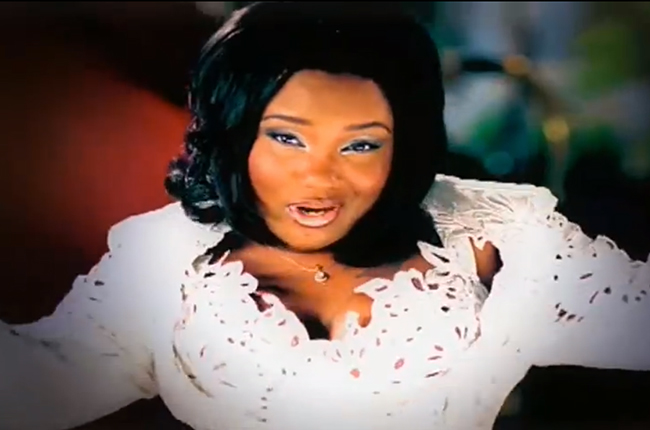
When I hopped on the phone with BbyMutha, she was in Chicago getting ready to hop in an Uber and head to lunch with a friend. The Chattanooga-bred rapper had just gotten her nails done and bought a few wigs, and was looking forward to “Renaissance One” later that night, a show put together by PartyNoire and “Red Bull Presents” to celebrate the city’s LGBTQ+ pioneers.

I spoke with BbyMutha about the pressure to constantly put out music, the importance of protecting the Black LGBTQIA+ community and her newfound method of selfcare.


NS: You’re on the lineup for the “Renaissance One” show that “seeks to elevate these progressive artists and pay tribute to Chicago’s LGBTQ+ pioneers” during Pride. How important is this month to you?
BM: I appreciate Pride Month for what it is and not what it’s being turned into. I feel like it’s a lot of commercial profit. These are people that you wouldn’t have thought twice about [at any other time]. 

I saw a lot of ads this past month with transgender women that I follow as the faces, and I’m happy for them. But at the same time nobody does anything for them when they need help. That’s my only problem with it. Now that I’m grown I can just be gay, and I appreciate being able to play at shows like this because I can really really just be me! With other people that are like me!

Right! And it’s important what you said about visibility, because for Black queer bodies with that comes a need for protection. 
Yes, you’ll see people get so mad and say “I’m not supporting this brand anymore because they had this person on there.” And then people attack that community. That’s the stuff that has me worried, because outside of the promotion there is no protection.

That was a bar! And people are out here getting hurt and killed.
And none of these brands ever stand in solidarity with them when it’s not Pride Month.

Yup! I put a rainbow on these shorts and…
[Laughs] Right, so you better buy it!

Crazy. So I have to ask you this. Someone the other day tweeted you and recommended you make a personal Twitter account to tweet “crazy” stuff in a separate place.
Yeah somebody tweeted that to me and they got me fucked up. I’m going to do what I want to do, I paid my phone bill. Especially not on for something as silly as social media. If you don’t want to see something I post cool, but that’s why you have an option. You’re not being forced to follow me. 

Within music, especially with the people who look like us, there is this intense pressure to act a certain way or maintain a certain image. Is there pressure for you to conform to an industry standard?
I don’t care about an industry standard, because it’s very untrue and I’m a bad liar. So I feel like even if I did conform to that people wouldn’t receive me well. It would come off as fake and not genuine. It would do me a disservice.

I also spent a lot of my life being told who I needed to be. And I still ended up getting rejected. You turn into these people the world tells you to be, and it’s still not good enough because now there’s something else you have to do. 

That’s such an important value to have, and certainly something I see whenever you share your kids on social media. They look so free and happy, which is a testament to your parenting. Is it difficult to balance motherhood and your music?
They’re hand in hand. People who say what you should or shouldn’t do probably don’t have kids, and they don’t have people around them that actually care about them. And for a long time I didn’t either and it was the hardest.

People just don’t know what they’re talking about. Yes I’ve had to take some L’s when it comes to my children, but from each L I grew and I learned. 

Everyone’s been asking so I have to ask, when can we expect the album?
I can’t even give no updates! I had a listening party and everybody thought that was the final [album], but I’ve added so much since then! It’s going to be crazy, it’s going to be worth it, and everybody is going to be like “damn okay this is why it took so long!”

In music people stay dropping stuff left and right, every month. 
That was literally me last year, and I’m not finna stress myself out this year! You do that and then people are like okay, throw that in the trash, where is the next one. Like nah, I’m gonna make y’all wait for this, it’s going to be good, and then you gonna sit with it for a while.

Do you feel like that saturates the market? An artist will drop a new thing every single week and I’ll be like damn are you doing this for some streams? 
I feel like it’s for the streams, and also nobody has the balls to say “y’all gon’ wait.” Everything is some supply and demand type shit, and that’s not what I’m on. Last year I put out five EP’s, I was doing that because I felt like if I wasn’t working on something I was a a failure. But it’s okay to work and keep it for a minute and sit with it. 

What do you to take time for yourself?
I just now got to a point where I’ve been trying to do that. And honestly what I learned this week is to wake up early. Waking up early, I have time to do stuff. When I get back home waking up early is going to do me some good. I can wake up before the kids, smoke and get my hair done before they get up, because that’s a lot of different personalities coming at me at one time. 

And being on tour. I just spent four days in Amsterdam by myself and at first I ain’t know what to do. After a while you realize that’s a form of self care too, spending time with yourself. And doing stuff that you like to do and not feeling bad about it.

Who are you listening to right now? What’s in your playlist?
Future never leaves my playlist, he’s my problematic fave. Asian Doll is really in my playlist right now, I like her. All the usuals, Young Thug, Gunna, Lil Uzi. He in my top ten! Earl, a lot of Earl lately because I miss being on tour with him. I really like Schoolboy Q’s new project. Key! 

People forget about him sometimes!
Forreal and I don’t know why, he’s a legend. And Nudy, I always listen to Nudy. And Hov, Nirvana, Bad Brains. 

That’s a good playlist. Before we go I know you’re in Chicago getting ready for the show and I want to know, what do you like about the city?
This is only my second time being here. It’s very Black and I love it. Black people everywhere.

25 Years Of Lil' Kim

tumblr_o8n11352LX1szbfero1_1280.jpg

by Brooklyn White

Lil’ Kim, the 4-foot-11-inch tall musician and model, is a force. She started out as the first lady of Junior Mafia in 1994, and over the span of her 25-year career has reinvented herself a healthy number of times. Her resume is long, reconfiguring the content women could present in Hip-Hop, setting new trends with her fashion, and remaining largely herself. Ever aware of her legacy as a fixture in rap music, one needs to look no further than Trina and The City Girls’ “fuck niggas, get money” or the style choices of Rihanna for affirmation. She is a legend who deserves it all and then some.

Who can forget the commanding opening line, “[h]ot damn ho, here we go again”? The way she is able to guide her vocals over winding soul samples and Latin pop, without getting lost, is a talent. “Musically, her cadence is one that other women in rap still have yet to emulate,”writes historian Karen Garcia. “Her transition to pop, [while] still being very Hip-Hop is also amazing. No one ever doubted Lil Kim’s ability to rap and make gritty music.” She has worked with ghostwriters, sure, but some of Kim’s most fun verses (“Lady Marmalade” and the “Not Tonight” [Remix],” were written without assistance. If it’s murder, you know she wrote it.

Men have always proudly shared their stretched exploits with anyone who would listen. Barbershops, game nights and break rooms become cringe-worthy hot beds for this kind of information sharing. “Boys will be boys”, chimes the decrepit patriarchy. They are encouraged to kiss and tell, circumventing the “hoe” label. Women however aren't given the same privilege. Those who are pro-hoe have moved past puritancal views and the gender binary is fading, but many cis-het men still cling to both as a way to exert control over women and the LGBTQ community. Thankfully, they remain unsuccessful. 

“Lil’ Kim made me feel comfortable with my sexuality,..saying what I want to say, how I wanna say it and not feeling sorry if people are offended. Also that there’s nothing wrong talking about sex or openly expressing my sexuality as a Black woman.” -C. Alexis, Tarot reader

“Got buffoons eating my pussy while I watch cartoons.” Imagine, for just a brief moment, the leisure surrounding this line. Not only was Lil’ Kim saying that she doesn’t take men seriously, but she was so used to sex that she can focus on other activities while being pleasured. She wasn’t the first woman in rap to discuss it - Salt N’ Pepa quite literally “talked about sex” in 1991. But what Lil’ Kim did differently was paint vivid pictures of her liaisons and consistently consider her own pleasure (even though she was unafraid to please her partner, too). “That's how many times I wanna cum, twenty-one, and another one, and another one, and another one”. In 2016, a study conducted by the Archives of Sexual Behavior revealed that heterosexual women are 30% less likely to orgasm during sex than heterosexual men, which is unacceptable. Lil’ Kim was not interested in sexual encounters that didn’t end with an orgasm and asserted the right for heterosexual women to have them too.

“Her approach to fashion and beauty was, and is, sexy, expensive and over the top.”

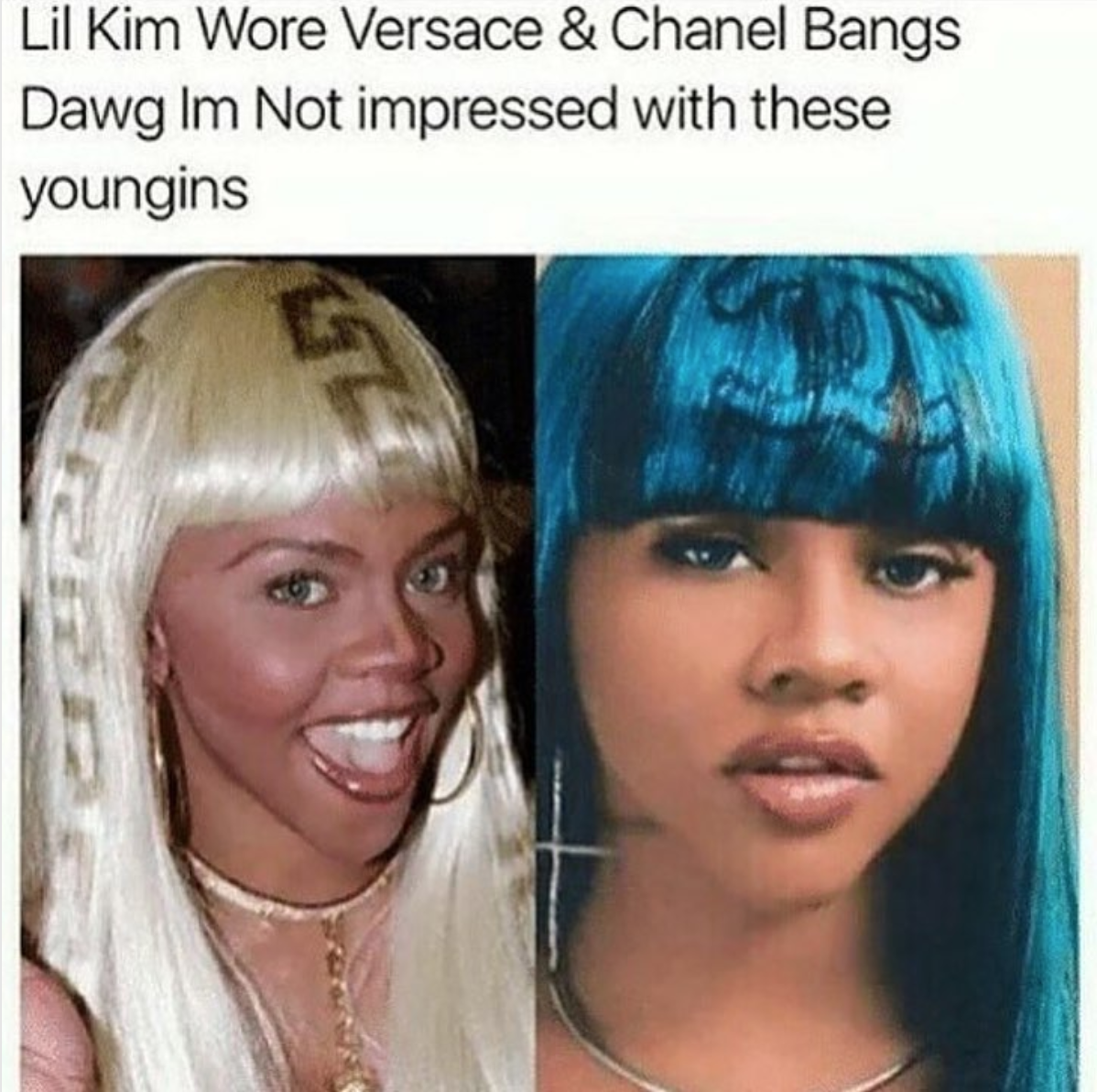
Of course, Lil’ Kim is also a fashion and beauty trailblazer. 20 years ago this year, she attended the MTV Video Music Awards in a custom, Misa Hylton designed jumpsuit that showed off one breast. The Brooklyn-born hustler also debuted two banged wigs with the Chanel and Versace logos spray painted on them in 2001. Her approach to fashion and beauty was, and is, sexy, expensive and over the top. Kim sometimes personifies camp - the bad-yet-good taste that was the theme of 2019’s Met Gala. No one else would dare step out in a blonde, Bo Peep-style wig, a bedazzled anti-mask or boots lined with red weave. The other girls just don’t have the guts, and that’s okay. Kim also walked for Baby Phat (recently revived in collaboration with Forever 21) and was featured in a campaign for Iceberg Jeans, erasing the lines between hip hop/pop culture and mainstream fashion. Luxury brands were leery of rappers for years, but Lil’ Kim was able to create meaningful relationships with multiple luxury brand designers, and quickly became a fashion darling.

So here we are. Two and a half decades into Lil’ Kim’s career and she’s still doing it. Still making art and inspiring rappers. Still speaking directly to women and showing them how to move through a world that doesn’t want them to believe it is for them. Dripping in Chanel and jewels on the regular. We know that she’s imperfect, we know about the beefs. We know that she’s imperfect, we know about the beefs. And we know about her struggles with colorism, abuse and body dysmorphia. She’s a fighter who deserves honor, and you better believe we’re giving it to her. It’s clear that Lil’ Kim is the Queen Bee and a trendsetter, and she’s still going awff.

Salma Slims Is Ready for Her Closeup

Screen Shot 2019-06-03 at 10.19.18 AM.png

by Brooklyn White

Salma Slims’ new project, Runway Rapper is here. It hosts features from Salma’s Private Club Records labelmate (and brother in-law) MadeinTYO, Slim Jxmmi of Rae Sremmurd and Ty Dolla $ign. The EP, as well as Salma, is inspired by Naomi Campbell, the cheeky model with an extensive career and indelible presence. But make no mistake, Salma Slims is her own woman.

The former cheerleader, girl group member and Lowes employee has come a mighty long way from having 9-5’s and juggling college courses. Her hard work has paid off though and now she has multiple high profile campaigns under her belt (including Calvin Klein) and over 200,000 Instagram followers who are ever excited about her latest moves. Read our email exchange with the runway rapper herself below.


Brooklyn White (BW): You're based in Los Angeles now, but you spent your formative years in Atlanta. How did living in the south prepare you for the types of people and events that you come across in California?Salma Slims (SS): Atlanta raised me. Taught me how to get it out the mud,... keep my foot on they necks and never let up. My mentality is fixed on that. Coming to LA, I’m the same person but I grind harder out here because this is an entertainment city and everybody is after the same thing - to make big. [I]t makes me go 10 times harder being out here.

BW: Your introduction to the music industry was in your teens, under Tiny Cottle's Pretty Hustle. Can you tell us  a little about that experience?
SS: My introduction to the music scene was actually with 247 Ent/Konvict music when I was in a group, and from there our group caught the attention of Tiny though a cypher we did that went viral…[S]he liked the fact that we were a rap group and it was something different that you didn’t see much of during that time.

BW: What do you want listeners to walk away with after listening to 'Runway Rapper'?
SS: Runway Rapper is a lifestyle. Being a bad bitch with lots of attitude and class. This [EP] has a mixture of everything and a little bit for everybody.

Hair and makeup by COYA BROWN, wardrobe by AMIRAA VEE, nails by ASTRID CURET, set design by SIERRA HOOD, set design by TEDRA WILSON, photography by RANDIJAH S and TEDRA WILSON

Hair and makeup by COYA BROWN, wardrobe by AMIRAA VEE, nails by ASTRID CURET, set design by SIERRA HOOD, set design by TEDRA WILSON, photography by RANDIJAH S and TEDRA WILSON

“I absolutely lovvvvvvvve Naomi..I feel like I’m her daughter and she doesn’t even know it. We have very similar stories - she grew up in a very religious home being [Jehovah’s Witness] and I grew up in an Islamic home.”

BW: How long did it take you to craft this project from beginning to end? Did any particular life occurrences motivate it?
SS: It took me about 4 months to finish the project[,] I’m in the studio every other day. I was just waiting on the label to drop the project, so it took forever to come out. I actually just finished a project with super producer Dun deal and it’s some of my best music, so I have so much music I’m sitting on right now.

RANDIJAH S and TEDRA WILSON

RANDIJAH S and TEDRA WILSON

BW: You've cited Naomi Campbell as a major influence, and that inspiration is evidenced on the cover of your project. What have you learned from her career and how do you juggle music and fashion?
SS: I absolutely lovvvvvvvve Naomi..I feel like I’m her daughter and she doesn’t even know it. We have very similar stories - she grew up in a very religious home being [Jehovah’s Witness] and I grew up in an Islamic home. She had so many doors [closed] on her but she still remained to go hard and now she’s the biggest supermodel in the world. I get a lot of my creative inspo from her. The cover of my project was paying homage.... I’ve always wanted to [redo] her PLASTIC DOLL portrait from 2011 that was shot by Seb Janiak. Shoutout to the photographer Brian Christopher, the graphic designer Weird Creative, and [creative director] FilthyMcDave for helping me bring that to life.

BW: Your most recent track is "Seasoning" - a ticking, thumping, bass-heavy track full of clever references and confidence. How did "Seasoning" come about?
SS: I was in the studio working with Camiam and he’s done a lot of huge records. The beat was so hard, I wanted the record to be the intro to my project. I just went in the booth and spazzed on the beat.

BW: What are your plans for the rest of 2019?
SS: [The] “Seasoning” video also dropped May 31st. And..I’m hoping to go on tour this year and take everything out the roof.

‘Runway Rapper’ is available on all DSP’s now.

This interview has been edited for clarity.

A Conversation with Schenay Mosley

SCHENAYHEADER.jpg

by: Nadirah Simmons

I first saw Schenay Mosley during the NYC stop on Smino’s Hoopti Tour. A singer and multi-instrumentalist whose music embodies Alternative Soul and R&B, she commanded the stage with ease and set the tone for the show, something that few lead acts can even do. Mosley, who moved to Chicago to pursue her education and music career attended a rehearsal for Smino and has been singing with him ever since, calling the St. Louis rapper and the entire Zero Fatigue crew a “genuine family” she can trust with her thoughts and ideas.

I immediately dug into her discography, captivated by her 2018 EP Lotus. We conducted a quick interview via email about what’s influenced her artistry, her creative process and more.


How did you get into music?
I got into music when I was 4 years old. I just started singing and realized that I loved it. I use to tap my fingers on tables when I was younger and eventually my parents bought me a keyboard. It's been history ever since. 

How did your upbringing and your environment influence you being an artist?
My Dad used to DJ back in the day (he still does now) and he always played music around the house. My cousin used to come over and make beats in the basement and I started learning how to produce from him. I grew up singing in the choir, taking piano lessons, you name it. I've always been drawn to the frequency of music. 

Who are some of your biggest inspirations musically?
Some of my biggest inspirations are Michael Jackson, Janet Jackson, Erykah Badu, Aaliyah, Whitney Houston, Prince, Stevie Wonder, Sade, Marvin Gaye, Beyoncé the list goes on.

What is your creative process like?
My process varies depending on how I feel. Right now I'm letting the music flow and I'm not controlling what I say or do. I just lay it all out in the booth and clean it up later. It feels more authentic that way. 

How did you link up with Smino? What has your experience touring with him and the Zero Fatigue crew been like?
One of my former friends told me he was looking for a backup singer and I agreed to come to a rehearsal--I've been singing with him ever since. And I love traveling with them, it feels like a genuine family, I know I can trust them with my thoughts and ideas. We always make sure the energy stays pure.

What is your favorite thing about being on tour?
My favorite thing about tour is seeing the look on everyone's faces when we walk on stage. I love the connection I have with the audience and I love instilling joy into their hearts through my gift. 

How do you identify, and how important is your identity when it comes to creating?
I identify as a spiritual being and black woman, first and foremost. And my identity is important since it is the lens in which I'm telling my story. I also like to write things from a human perspective since I am more than the color of my skin. 

What inspires you to keep going?
This indistinguishable fire inside of me, it's like I HAVE to do this. I have to share my gift and help people in a certain way and this is it. 

Where do you see yourself in 10 years?
I see myself selling out stadiums and enjoying my career with my beautiful family.

Texas Women Are Rapping Their Way Into A Brighter Future

Screen Shot 2019-05-13 at 10.35.12 AM.png

Like America as a whole, the history of Texas is racist, sexist, and selectively shared. Fortunately, archivists like Bri Malandro and BOONAPALISTA are using the internet and images to shed light on the true stories regarding historical events. Malandro’s term “The Yee Haw Agenda” (a nod to Black folks in western wear) has wrapped itself around the world wide web, prompting conversations about the way we consider cowboys and their whitewashing in Hollywood. The timing is nearly divine, with Lil Nas X enjoying his fame as a musician with country and rap influences, the Kentucky Derby recently rapping up, Solange Knowles rolling out her ode to southern living with When I Get Home, and fans witnessing a meteoric rise of Black women from Texas who make fiery, honest rap music about their surroundings.

For over 10,000 years before colonizers drifted to Texas, Native Americans lived there and got acquainted with the land, themselves and each other. When European squatters came during the early 1700’s, they brought religion and deadly illnesses, and some were not met with kindness (excluding the trade-eager Caddo). Eventually, this kindness would not be met with any, as Caddo tribe had dwindled by 95% by 1816. There were multiples countries who staked claim to Texas until it claimed its independence in 1836, but this obviously was nowhere near the end of ethnic and racial grievances in Texas. Legal Black slavery continued until 1865, Black and Latinx folks have been strategically ignored during voting seasons, the deaths of Sandra Bland and Jordan Edwards rocked America to its core.

As always, Black people (and women, specifically) have done the work required to shine a light on injustice, entertain while healing, and make Texas a safer space for others. Late last year, 19 Black women made history when they were elected as judges in Houston and Beyoncé continued to heighten cultural awareness with her Homecoming documentary. Additionally, women from Texas are rapping to regain control of sexual narratives, advance themselves financially, and spread messages of empowerment, fun and freedom.

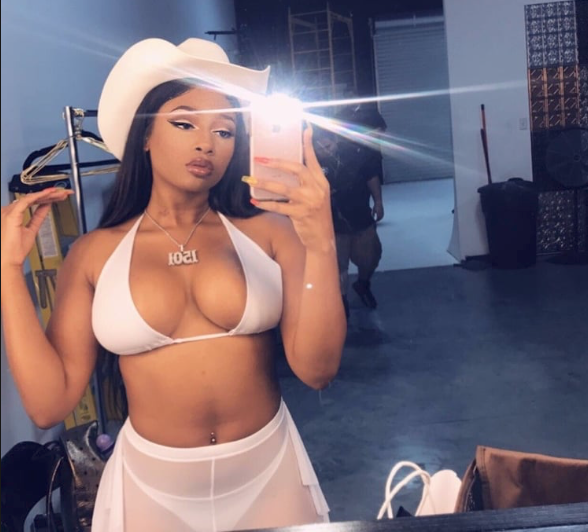
“Megan from Houston, I’m naturally sexy” is a bar from Megan Thee Stallion’s impromptu “Still Tippin” verse. Like the original performers of the southern cut, Megan reps Texas hard, as shown by Pimp C-inspired verses, cowboy hats, and frequently flaunted “H Town” hand signal. In her 2017 video for “Last Week in HTx”, she takes fans on a trip to some of Houston’s landmarks and highlights the devastation the city endured during Hurricane Harvey. She states her own struggles, saying “every..night I was eating cheese eggs.” Thee Stallion has kept her homestate in her heart, mind and music as she climbs the Billboard Hot 100 with “Big Ole Freak,” sells out shows, and posts up with fellow Houston-born royal, Solange.

“I feel like I have to put on for my city, because we have so many legends and so many greats,” Megan Thee Stallion, Rolling Stone

A newly christened Asian Da Brat [FKA Asian Doll] hails from Dallas, Texas and in a documentary with All Def Digital, she went into detail describing the early days of her career. “I [stayed] in the hood, [our curtains] had..tacks. I didn’t even have a bed,”. That kind of poverty in Latinx and Black communities is all too common in the Dallas-Fort Worth area. According to statistics shared in May of 2018, nearly a third of Black and Latinx people living in Dallas are living below the poverty line, respectively.

Screen Shot 2019-05-13 at 11.20.37 AM.png

“I want to know everyone where I’m from and I love repping Dallas. It’s always been more of a Texas thing, though...Texas is so slept on. I just want to put on for my city and state as much as I can and show everyone that we’re here.” -Asian Da Brat, Billboard

Making it out of poor neighborhoods is a goal for many young people who dream big and work hard to make their talents shine. Dallas is a city that’s booming with flair, and hopefully it gets to the point where the resources and opportunities align. But as homeless communities swell and more youth feel forced to turn to the streets to support themselves, there’s no telling when the tide will turn. But, Asian Da Brat is here to guide her peers every step of the way. She regularly encourages Black youth, especially women to hustle, be wise, and maintain their confidence.

Cuban Doll makes vivid, quotable music too, and has talked about becoming a woman while her mother was in jail. Growing up with an incarcerated parent is an under discussed reality that has had an affect on tons of non-white kids and teens. So, the Dallas native sharing her feelings about the last few years of her upbringing holds weight. In a short amount of time, she’s organically grown a large following and has drastically altered what could’ve been perceived as the trajectory of her life.

Black people and people of color have faced socio-economic disparities since European settlers entered Texas. But brilliant Black women are changing the story around their culture and shaping their future. Everything is litter in Texas fosho.

Rap Groups Comprised of Women Help Progress Black Feminist Thought

salt-n-pepa-essential-songs-listen-637d6f74-8e06-4087-ae3d-d3d81ed4d98d.jpg

by Brooklyn White

The Black woman’s voice is critical. Without it, the earth is cursed - condemned to a lifetime of misogynoir and Eurocentricity, and devoid of discussions on the intersection of gender, race, and class. There have been too many instances of erasure, or worse, a flat-out lack of knowledge on the various issues that affect Black women. Even more necessary than individual, Black feminist thought is the collective consciousness and inventiveness that Black women have cultivated since the beginning of time. As a result rap groups comprised of women have performed bops and have fostered solidarity amongst Black women.

The fusion of Black feminism and rap (created by Black women, of course) is not shocking. Both have a buzzing nucleus that summarizes the differing aspects of Black women’s experiences across industries, institutions, within family units and more. Romantic relationships, socio-economic plights, basic relations, and coping mechanisms are among the topics tackled in both rap and Black feminist’s conversations. Fellowship amongst Black women is fostered as a result of this sharing of information. And while entertainment plays a large part in the consumption of the art created by Black women rapping, there is an equally strong desire for a sisterhood. I cannot think of a better display of the connection between Black sisterhood and Hip-Hop music than groups made up entirely of women.

The Sequence is owed much more respect than they’re given - one of the first women collectives to make a big splash in Hip-Hop (in 1979). Though the Sugar Hill Records signees have been sampled by large performers like Dr. Dre, they still haven’t gotten their credit, or their coins, and they’re not happy about it- the typical underpaid, overworked bullshit that Black women have been enduring for centuries. But the ladies haven’t let financial issues and misappropriation of honor deter them from sticking together in pursuit of loot, and have managed to create an avenue for others, like Salt-N-Pepa and the City Girls. The women have also made folks reconsider how we honor living, Black predecessors.

“Pick up on THIS!” proclaimed a James Brown sample placed in Cheryl “Salt” James' and Sandra “Pepa" Denton's “Push It", the legendary anthem that thrust the New Yorker's careers into the cosmos. And pick up on it we did.   

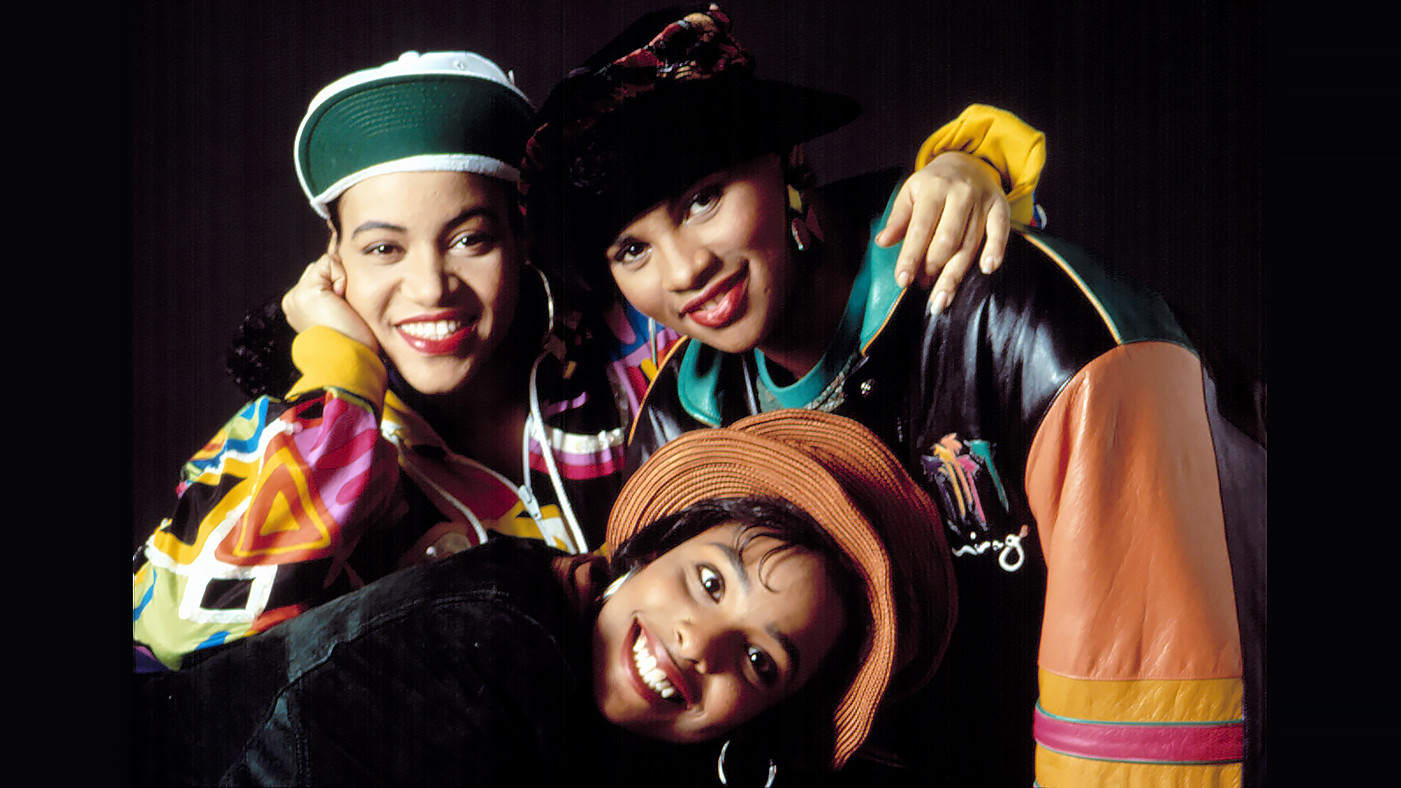
Early on, everything about Salt-N-Pepa cemented their solidarity, from their matching asymmetrical haircuts (the result of Pepa’s hair coming out during a perm), to their names. The group had a string of hits in the 1980s and 90s, while approaching still-discussed concepts like not needing a man for his money and their sexual philosophies, and were the first mic-wielding women to go platinum, and also among the first to win a Grammy. Salt-N-Pepa have been making strides in the name of feminism for over 30 years, and inspired women to think more critically about the societal guidelines they color within.

The West Coast, as well as the Panhandle State presented their women-centric duos and trios - J.J. Fad and Oaktown’s 3.5.7 of the former and Anquette and L’Trimm of the latter. Supersonic, boomin’ whips were a sliver of the outcome of these bands, who continue to find new listeners and spark conversations. The very existence of communities of Black women who celebrate themselves, support themselves and uplift others like them is worth consideration.

J.J. Fad, ‘Supersonic’ cover art, 1988.

J.J. Fad, ‘Supersonic’ cover art, 1988.

Some might argue that JT and Yung Miami of the City Girls are not feminists. And a conversation on their musings and music (Alexa, play “I’ll Take Your Man” [by Salt-N-Pepa]...wait no, actually play “Take Yo Man” by City Girls) could support this belief, while simultaneously reinforcing the longstanding Black feminist tradition of rejecting the pathologizing of Black women’s relationship with their bodies and sex. And when you break down JT’s incarceration and find that it’s a matter of capitalism and the struggle to pursue the American Dream as a young, Black woman and Miami’s redistribution of wealth in the form of $25,000 awarded to the best twerker in the world, you may be inclined to think more critically.

It’s true that we live in a time where the term “feminism” often becomes a buzzword for brands and outlets who hover over the concept like gnats and slap it onto anything concerning women. Similarly, many are quick to call mundane and completely unintentional acts “iconic” and “radical.” I won’t be pressed if my theories regarding the feminist nature of certain Hip-Hop groups are challenged. I find solace in the fact that like The Sequence and Salt-N-Pepa, I’m elasticising the bounds of Black feminism and its purpose, while pushing the conversation forward. Period.

A Conversation with Teenear

teenear.jpg

by Nadirah Simmons

In a music environment where viral moments and Internet clout can make or break you, singer-songwriter Teenear has both and a whole lot more to offer on top of that. The 20-year-old singer started out singing covers on YouTube as a teenager, and today is signed to Slip-N-Slide Records. Not to mention her video for “Need Your Love” has is close to 2 million views on YouTube. It’s the kind of success artists who have worked for years dream of having, and the kind Teenear has to be proud of achieving at such an early stage in her career. But even with all of those wins under her belt, she’s just getting started.

We talked with Teenear about the roots of her music career, how spirituality influences her sound, the importance of asserting her voice and more.


When did you decide that you wanted to start making music?
I was born and raised in Miami. And honestly just growing up in Miami, the scene with Southern type records, I was always around it and it wasn't necessarily something that I was interested in immediately. In school I was doing entertainment and musical theater was like my thing. And then around the age of like 13, 14, you know when you're in junior high you're trying to figure yourself out-that’s when I was like “okay let me see what I want to do.” I started venturing out and trying different things with musical theater and to be honest to the studio I never tell and I just started going it was at the time Justin Bieber had just came out and I'm like “who is this kid?” I went to look him up and he came out with this contest where you had to write to one of his beats. And one night I just sat there and did that contest for myself I never put it out. But just that experience of creating something is what sparked it for me.

Then I joined the praise team at my church, and the CEO of Slip-N-Slide attended the church. And it was really just word of mouth, people telling him “you have to come see her sing.” And one moment he was there, he heard me sing and it was really just a conversation of once again taking it seriously. So I started posting my covers on YouTube and he knew this is something I wanted to do so he let me get in the studio.

That's amazing. I know you said that you're from Miami. How has your environment or that community in particular kind of influence your love for music?
I really just feel like Miami is such a creative space. There are so many artistic people here and that in and of itself is what inspires me.

A lot of our favorite artists have their roots in the church. What role does that play in your music making process? And does how does it either encourage or discourage you from talking about certain things in your songs?
Yeah for sure. It's a battle with me because I'm a very spiritual person and I'm still like a growing adult you know. So yeah when it comes to my music there are moments where like I want to do certain things I'm like maybe I shouldn't say that. I want to make sure like I'm a positive influence but I know it it's constantly going to be a battle because I don't want to say something that might get the wrong reaction you know. But I feel like it comes with growing and growing in me spiritually and growing and music. I'll figure out my balance. But yeah definitely a struggle.

Is there any pressure from anyone around you, not just management but the industry in general, to change who you are? As far as you know how you present and what you do decide to sing or talk about?
One hundred thousand percent. And it could be people that honestly don't have an influence on anything I do in my career but it happens all the time. I hear “Oh Teenear you need to wear this you need to do this you need to say this you need to be more sexy.” It's like leave me alone. Let me do me.

When did you like know for sure that this was what you wanted to do?
For sure it was when we wrote my first single because we recorded so many different songs and it was frustrating. I was like maybe I shouldn't be doing it. It wasn’t until we wrote [the single] that everyone actually loved that record. Out of all my other songs I had recorded before that, I finally felt like “okay this is definitely for me.”

So tell me a little bit about this song “Need Your Love.” When did you come up with the idea for this song?
This song was honestly just the ultimate definition of young. There’s people telling me I need to be careful and then I don't know and I don't know if this is love or lust. So this is a personal song for me because I deal with it right now. I'm young. I don't know what love is. Do you know what love is? Just young love and just having fun trying to be in the moment, even though you're hearing a hundred opinions.

I feel like a lot of times, especially when you're younger, you have this perception of what you think love is. And people are so quick to like shoot shoot you down like “no that is not what it is, this is and you'll know when you get older.” But it's doesn’t take away from what you’re feeling at the time. You're 20 years old and not just with the idea of love but also with you being an artist, you are super young and there are a lot of older people around you making decisions. How do you make sure you maintain like your voice and you assert your truth?
It's definitely really hard but I have a good team, we definitely have grown to work together. They listen to me, and if I have an opinion they actually do take it into consideration.

Before we got started we talked about artists who inspire you and you named Beyoncé. How do you feel about the people who just treat music kind of like a hobby or as a get rich quick type of thing?
I started out when I was young. I literally recorded all my covers in my closet. That is crazy to me you'd think from my back then now and when it comes to social media, honestly I feel like at the end of the day if you're not going to put 100 percent in something if you're just doing it for like one reason or for the moment it's going to come off that way. And like you said, Beyoncé worked so hard to get what they got. And if you're not going to do that it doesn't matter how many followers you have on social media that moment is going to come and go and you're not going to last. It’s up to how much effort you put into whatever it is you try to. You can do it, do it but right.

How do you separate yourself from all of the other singers and the other women who are trying to do the same thing? How do you make sure you stand out? Honestly I'm really trying to just be myself when it comes to it all. I'm not trying to follow the next person Even when it comes to like my music; none of my songs sound the same at all. “Need Your Love” is R&B, “Friday Night” is nowhere near R&B. If I like a song I'm going to put it out-I’m not going to stay R&B or because do pop because everyone telling me to do Pop. It's just how I feel, I'm going to be myself no matter what, today, tomorrow, five years from now. That's what I want to stand on. Being who I am because I have to look back on this, and I want to be proud of everything that I do.

So what is the story that you're trying to tell or that you want people to really take from your next EP.
I really just want them to see that I'm being unapologetically me like that. There's a hundred styles in it and I feel like it's definitely going to make people understand that I can't be placed in a box. I want them to just get that like this music is just me speaking, like it really is who I am.

That’s amazing. Where do you where do you see yourself 10 years from now?
I want to already start another business for myself. I'm really big into like health and like young girls and that's a goal for myself. Whether it's in five years or ten years but I need to make that a thing by ten years. And also just being in not only the music scene but also in the acting scene because musical theater was my thing when I was younger, I love acting, I love singing, so being able to do all of that by then will be amazing. Just being an artist that people really look at and really are inspired by.

What advice would you give to a young woman who wants to do what you're doing?
I would just say be yourself, 100 percent. And believe in yourself, because at the end of the day you don't believe in yourself nobody is going to believe in you no matter how much you try to fake it. It's just not going to work. And just go for everything. If you have a feeling just go for it no matter what. If there's people telling you you can't do it, just do it. I think it just comes down to this believing in yourself. Just have faith.


Eccentric Women Have Made Some of the Best Hip Hop Music + Videos

Tierra-Whack.jpg

by Brooklyn White

Tierra Whack’s 2018 debut album, Whack World, was a Dr. Seuss-like doozy. It’s been celebrated for its minute-long songs, reminiscent of HitClips, but also for offering the deep dives and productional experimentation present in 50-minute projects. Whack discussed high fashion (“Hungry Hippo”), healthy eats (“Fruit Salad”), cappers (“Dr. Seuss”), and more, but what helped grasp the collar of the general public were the nearly surreal music videos. The Whack World videos (meant to be viewed consecutively, but perfectly trimmed 15 times to fit the 60 second limitation of Instagram videos) are weird. But not the “oh no, my ex is behind me in line at the gas station, is my card gonna decline?” cringey weird. It’s the perfect kind of individualism that inspires people to fully explore themselves.

In her short film, the Grammy nominated artist sported a prosthetic swollen, drooping face and revealed a Guess Who? board that exclusively featured her mug, and fans, new and old, ate it up. People have long complained that music videos have lost their creativity in the last 15 years, but Tierra’s kaleidoscopic view into her mental and emotional states circumvented any such accusations. The album was reflective of her overall self and overlapping brand, her gif-like promotional clip for “Unemployed” is a visaged potato jumping on a couch (an out of the box, “couch potato” reference”) and her music email reads “GRANDMA STILL HAS SEX”.

View this post on Instagram

“Unemployed” Out Now! 👑

A post shared by Tierra Whack (@tierrawhack) on

Of course, Whack has been compared to Missy Elliott, the mother of all things masterfully unconventional. Elliott’s lyrics are often onomatopoeic, telling, and funny, with an energetic delivery to boost. Her sophomore LP, Da Real World, turns 20 in June, and its best video, “She’s A Bitch” is out of the ordinary and without mar. Partially monochromatic and directed by Hype Williams, in one shot, the multi-million dollar music video presents a jet black, bald Misdemeanor, emerging from the subaquatic abyss with a number of skilled dancers. This is two years after making herself larger than life with the help of a trash bag, and also letting people know that slim women aren’t the only barbies. These messages are radical, especially for their time, assisted by the creative ways in which they were conveyed.

Maryland’s Rico Nasty is on her own wavelength as well, having rocked spiked hair with wispy baby hairs (“You don't have the balls to walk outside looking like this”, she’s said), or swirly, sharp, seashell colored nails. Her Zack Fox-directed video for the loose single “Sandy” is an amalgamation of zany images, including stairs covered in neatly places slices of bread and a foot dipped in spaghetti. Her face isn’t included in the mashup, but her personal eccentricity is alive in other videos like “Guap (LaLaLa)”. Nasty’s guttural verses are unlike any other right now, and are possibly only comparable to DMX’s own coarse approach. But her willingness to fully embrace punk influences and create her own stylistic trends ultimately separate her from the Ruffest Ryder. Rico is her own woman, standing in a winding, animated lane.

These are certainly not the only women in rap to disregard public desires and instead forge their own path. Doja Cat, the anthropomorphic bovine, went viral in 2018, and who can forget Nicki Minaj’s camp era (complete with sky scraping wigs and a surgical mask)? The conscientious weirdness jolts people, usually because deep down, they are afraid to show off their own healthy peculiarities. They play it safe, deep within the shell of their own ego, held captive to others’ opinions. If only these people knew that their freedom and joy, and maybe someone else’s, lays right outside of that shell. Always remember that weirdness is courage, and courage is the core of life.

A Conversation with Yung Baby Tate

TATEEDIT.jpg

by Nadirah Simmons

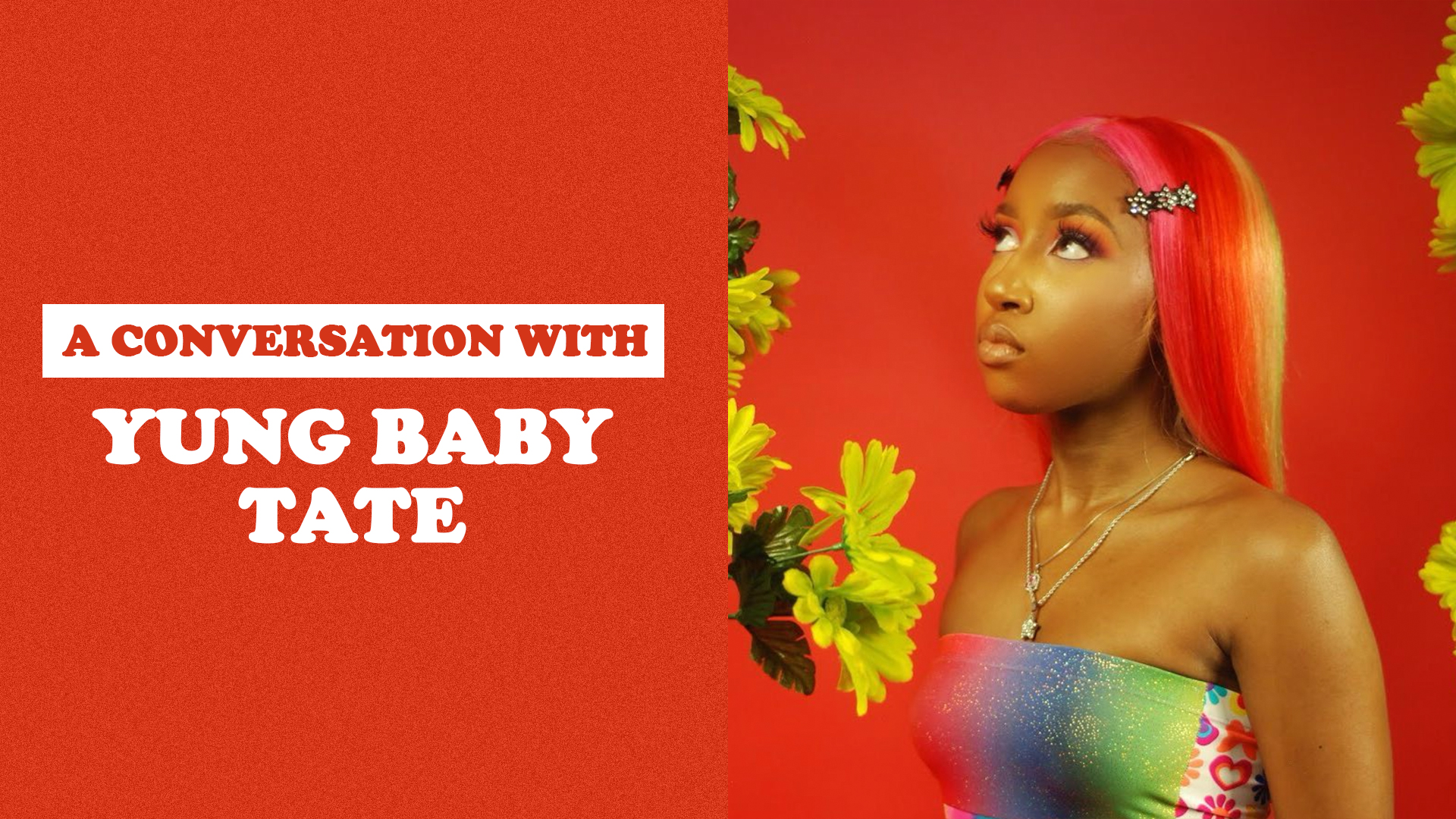
Yung Baby Tate is a multitalented artist, whose creative ability knows no bounds. Not only does Tate rap, sing and produce, but she’s good at all in three in a way that doesn’t feel dubious. Tate is confident, resolved and constructs her music with certainty, effortlessly bouncing between genres. She’s the kind of artist you long for in music, and I argue even more-so in Hip-Hop, where unspoken rules dictate what artists should do, how they should dress, what they should write in their songs and at the most basic level: who they should be as an artist. Tate can’t be boxed in.

I first discovered Tate around this time last year, when her EP BOYS had just dropped. I’m not sure if the discovery happened on SoundCloud or Tumblr, but the track “Bubba Gump” was what hooked me to the Atlanta native. I did more digging, listening to her 2015 project ROYGBIV and even a Christmas EP that found her singing over pop and R&B harmonies. Her latest project, a full-length LP entitled GIRLS picks up right where her last release left off, with Yung Baby Tate transcending sounds while remaining herself at the core.

We caught up with the multitalented artist to talk about what it means to be an artist, the sound she describes as “urban pop,” her dream collaboration and more.


What does being an artist mean to you?
Being an artist means being myself and using the gifts God has granted me to bring joy into the world. Being an artist is self expression, self love, self indulgence and selflessness at the same time. The vulnerability it takes to openly express yourself for the entire world to hear, love, hate, relate to, or critique is scary at times but that’s what being an artist is all about. 

How do you identify, and how important is this representation in music?
I identify as a bisexual black woman. I think all people should be represented in music, tv, in politics, anywhere that has some type of broad visibility. Everyone needs to feel seen and heard and understood. It’s important for me as a black girl to show young black girls they can be successful by just being themselves - every part of themselves -and shining their light in the world.

How would you describe your sound?
I would describe my sound as “Bad Bitch Pussy Pop.” My music is for the gworls. I exist in music to be a boost to your day, that extra highlight when you’re getting ready at night, I am that friend hyping you up while twerking. My sound is fun. My sound is black girl magic. You could call it “Urban Pop” if you really want to put a label on it.

How has your education and upbringing affected your creative process?
I went to performing arts school from 3rd-12th grade. I’ve been professionally trained in music, acting, piano, and dance throughout those years and after high school. Having that type of upbringing just expands my knowledge and love for music so that when I make music I actually know what I’m doing. A lot of artists right now don’t know the first thing about composing a song or arranging vocals. I’m grateful to not be one of those artists.

Your mother is the legendary Dionne Farris, what role has she played in your path as an artist?
My mom raised me to have knowledge and culture in music. She made sure I was well rounded and well versed. A lot of the songs that the grandmas and aunties of today tell kids my age and younger “you don’t know nothing about this” I know a whole lot about. She wanted me to be educated in music so she made sure I got the proper training that would strengthen my natural inheritance from her. I got a lot from my teachers and instructors but my mom really taught me everything I know.

A while back you tweeted a picture of her pregnant with you attending the GRAMMYs, what importance, if any, do those awards shows play in the realm of music? Do you feel like institutions like that are equipped to reward art, especially art created by marginalized communities? 
I think all awards are what you make them to be. For me, it’s something I want to accomplish because of the legacy I want to carry on from my mother. I just know that feeling of growing up looking at my mom’s GRAMMY sitting in the dining room every day and telling myself I’m gonna get one one day. I think the “best” is a subjective term. But I want people to think I’m the best at what I do and I think a lot of people share that same sentiment.

Photo Credit: Dom Daytona

Photo Credit: Dom Daytona

What was your vision for GIRLS?
My vision for GIRLS is a shift in the culture. Women calling the shots in this long “male-dominated” life we’ve been living. I want girls to feel the power they possess through this music. I want other women in the industry to collaborate more. We need each other. I wanted to show that. Young girls need to see that. We can succeed together, without tearing each other down. We can do things on our own. We can produce albums, write our own lyrics, make our own music without the assistance of a man. I want Girls to be a lesson. 

We are alive in a time dominated by social media. How important is it for the artists nowadays to brand themselves and present their work in this manner?
It’s extremely important. It’s where everyone gets their news now. It’s where everyone gets their “new’s” as well. New artists. New designers. New dancers. New everything. Social Media is a large part of my career and how a large part of my fan base found me.

What does your city offer musically that is different from other regions?
Everything. I’m from Atlanta. Specifically Decatur, which is where a large percentage of the most popular artists are from. I’ve seen grown adults with whole lives they’ve left behind move here from other cities just to claim Atlanta to look cool. Atlanta is on top of everything. We start everything. 

I’m a big fan of Black women taking time to relax and practicing self care. Outside of music, what do you do to receive stress and/or relax?
Sleep. Sleep. Sleep.

Your album features some of my favorite women in the game, Bbymutha and Kari Faux, how important is fellowship amongst women in music to you?
It’s so important to me because for years we’ve been pitted against each other when we are so much stronger together. It’s almost as if people know the power 2 or more women can hold together so they purposely try to make sure that doesn’t happen. I’ve never been the type of person who had to hate on someone else to feel good about myself. I give props when due and let my ego step aside when it comes to the art. The fact that I have five women who’s music I love on this project is honestly my favorite thing about Girls.

We’re in a time where it seems like politics are central to the art artists create. Nina Simone once said “An artist's duty, as far as I'm concerned, is to reflect the times.” Do you agree or disagree, and why?
I think it would be kind of backwards to not somehow reflect the times and have some sort of commentary on the world we live in. As an artist, I use my music and my social media platforms to spread positive messages into this world and I definitely think every artist has the right and responsibility to do so as well. 

What is your dream collaboration?
My dream collaboration is Pharrell. Imagine a project produced and written and performed by us both. Iconic. It needs to happen so I know it will one day. I’m waiting on you, P!

If you could sum up your plan for 2019 in one sentence, what would it be?
My foot will be stuck on your neck.

10 Years of 'In a Perfect World...'

large_172062_g2Fk7uTnzSXgNHFB21GncOvjO.jpg

by Charne Graham

It’s the year 2009 and you just finished picking out a spandex color-blocking fit with studded heels for the party tonight. Getting dressed to music is imperative before a night out and of course, CDs are still a thing. You press play on In a Perfect World…, Keri Hilson’s debut album.

The fourteen track project from the Decatur, Georgia native is filled with party tracks and sexy deep cut slow jams alike. Set to be released in 2007 but pushed back several times due to issues with the budget, the album would go on to earn Hilson two Grammy nominations for Best New Artist and Best Rap/Sung Collaboration at the 52nd Annual Grammy Awards. That should come as no surprise, as Hilson has an illustrious history of writing hit songs for some of music’s biggest names like Ciara, Usher, Ludacris, Britney Spears and Omarion.

A bulk of In a Perfect World… is produced by Timbaland, Danja, fellow Georgian, Polow Da Don and Hilson herself. The features are star-studded as well with appearances from Keyshia Cole, Trina, Kanye West and Lil Wayne. On the 10 year anniversary of its release, here are three of the most notable and impressive singles from Ms. Keri Baby’s debut.


1. “Turnin’ Me On”  - The album’s third single featuring Lil Wayne is produced by Polow Da Don and Danja. The song gave us a futuresque vibe and peaked at No. 15 on the Billboard Hot 100 chart. The visual that accompanied “Turnin’ Me On” finds Keri in rockstar attire surrounded by shirtless buff men with a white backdrop giving a new perspective to the typical scantily-clad music video eye-candy. Besides Weezy, other stars make appearances in the visual like Rich Boy and Polow Da Don.

2 . “Knock You Down” - The fourth single from In a Perfect World… and her highest peaking song ever on the Billboard Hot 100 at No. 3. The double platinum song, co-produced by Danja and Hilson and featuring appearances from hitmakers Kanye West and Ne-Yo is all about how love catches you slipping at the least expected moments. This music video is set in a swanky loft party which also a complete era of the late 2000s fashions. Remember fingerless leather gloves? Kanye and Ne-Yo both play a love interest of Hilson in a love triangle at this party. “Knock You Down” is undisputedly one of Hilson’s hugest songs and also got her one of her two Grammy nominations in 2010 for Best Rap/Sung Collaboration.

3. “Make Love” - The video, released on March 9th, 2009 was used as a promo for Hilson’s album. The “Make Love” also features Kanye West, and finds him cuddling in bed with Keri Hilson after she comes home to prepare chocolate covered strawberries and champagne. The promotional video cuts the five minute and 22-second song short at three minutes and 14 seconds successfully teasing us and wanting more.

Why "Buffalo Stance" Remains the Blueprint for Confident Black Girls Everywhere

neneh-cherry.jpg

by Christine Ochefu

It’s been 30 years since the release of Neneh Cherry’s “Buffalo Stance.” At 8 years old I sat crossed legged in front of the TV set when its video popped up on the screen as part of an 80’s throwback mix. My mum instantly recognized the opening scratches, launching into a retrospective tale about the song’s success and singing the chorus without missing a beat. Doorknockers glinting and head cocking with each move, Neneh glided through her storytelling verses over the sounds of cowbells, offbeat saxophone and near-comical cockney adlibs. Cherry, in all her mean-mugging, curled-lip glory, was eyeing me fiercely on my TV screen, spelling out a punchy refrain of “don’t you get fresh with me” in front of two crazy-eyed, gyrating ladies. I didn’t understand it, but I was hooked.

Moving between Sweden, London and New York, Cherry’s history partially explains the uniqueness of her music style and individual appeal. The half-Sierra Leonean half-Swedish artist started her career at the age of 15, appearing in punk bands like The Slits and experimenting with DJing before releasing the 1988 smash hit “Buffalo Stance.” The song was one of the major British tunes to capture both UK and US audiences that year, reaching No. 3 on both Top 100 charts after its release. Even more impressive was the competition with the other music released that year. Cherry’s release came alongside classic Hip-Hop debuts from artists like NWA, Slick Rick, and MC Lyte, but still managed to perform successfully with both international and UK audiences. For a 24-year-old artist with counter-cultural and punk roots, this was far more than a small feat.

Despite only briefly grasping the content of the track, her delivery and confidence impacted a young Black woman like myself. Cherry made for a complete exercise in genre-bending, with her cadence seeming to be directly influenced by her punk roots. Propelled by a catchy yet assertive refrain “No money man can win my love,” the song is both textbook braggadocio and a quirky dressing down of the “gigolo on the street” soliciting her to stock up his funds. Jumping from pop elements to dance production to a bridge resembling spoken word, Cherry’s boldness in the video and captivating delivery had grabbed me - I knew I wanted to be that woman on the screen.

My mother, too, found Cherry’s presence important. She told me “There was just something about seeing a Black woman making music like that and being so well received and acknowledged.” As is the situation with its American counterpart, Black women have historically struggled to be acknowledged and gain visibility in the UK Hip-Hop and rap industry, something we’re still grappling with now. With Black women afro-trap, grime artists, DJ’s and music industry professionals working hard to assert the right to spaces contemporarily, she echoes my sentiments in garnering support for Black women in the scene. “It’s the kind of thing I’d like to see more of now, people really getting behind Black female artists.”

Since “Buffalo Stance” Neneh has created by five eclectic solo albums and endless collaborative projects, giving us further classics like 7 Seconds, Manchild and a recent work entitled Broken Politics, that deals with critical subject matter like the refugee crisis. Nevertheless, it’s important to return to the title track which first beckoned wider ears to her talent and acknowledge her for her classic place in Black British music history. As a Black woman artist being celebrated for her musical output, she’s worked to cement a place for Black women artists globally with the positive reception to her music on an international scale. I can never forget its significance to little Black girls like me who’d mimic her body movements, classic lip curl and fierce gaze to the audience of our bathroom mirrors, as a kind of ritual to channel Cherry’s confidence through our own imitations. On her 55th birthday, after over 30 years in the music industry, there has never been a better time to celebrate the timelessness of “Buffalo Stance” and importance in her fan’s hearts. And I will never forget its importance in mine.

A Letter to Bbymutha

tumblr_pcugq6g6O21qgh0wao1_1280.jpg

Brittnee, 

I chose to write you this letter to because you’ve inspired my growth as both a woman and creative. So let’s just call this “give em their dick ride while they’re still here.” Lol. This is me, appreciating you and how you change the narrative of being a woman and a mother of four, pushing the culture one step further. It’s admirable. 

I first found your music on SoundCloud about four years ago and immediately became a fan. It was so compelling that I had to reach out to you and tell you how I felt. I’ve watched you blossom and grow into such an incredible woman and artist while staying true to yourself, your purpose and your passion. 

You are hardworking. You are ferocious. You are passion in female form. You go after everything you deserve while raising four kids! Meanwhile some of us have a hard enough time pursuing our passion by ourselves-this is what I mean by inspiring.

I also love how raw and uncut your music is. You say things that resonate with a lot of Black women. You aren’t afraid of societal norms and it shows, not to mention the sound of your voice is as strong. Lol. It has a sense of power. One of my favorite quotes, “see these niggas only love you while ya happy. Love you when you bone straight, cut you when you nappy,” whew chile! If this ain’t a WORD.

People will really love the idea of you but won’t wanna deal with the flaws and everything else that makes you whole. So thank you for reminding me to show up and be myself in not only my creative space but every space. 

I’ve watched (via social media) some of your “fans” disrespect, bully and be verbally abusive to you out of pure ignorance and lack of understanding. But you’re brave enough to handle it, and I’ve witnessed you take your power back from their negative words, flip it and turn it into something positive for yourself.

My focus words for 2019 are fearless, confidence and love. You embody that. I encourage women to move with persistence and authenticity. Stay true to who you are, stay true to your purpose and stay true to your art. I support what you stand for and I hope you continue to inspire Black girls like myself all around the world. Thank you for being who you are. 

- Angel 

Mia X's Legacy Stands Tall after 35 years in the game

mia-x-imma-shine-650.jpg

by Brooklyn White

Who is the queen of southern rap? That’s a loaded, borderline unfair question. In the early days of rap, up until the mid-nineties, rap was certainly a coastal game. That’s not to say women artists in the south weren’t making music - they just weren’t the face of it, nor was the overall culture even prepared to digest a southern male act. Women like Salt N Pepa, MC Lyte, and Lil Kim dominated, and it made sense. Hip-Hop was born and bred in New York, and crept over to the west for brutal and spirited perspectives. In 1995 the south was ready for its close up, with a young, freshly booed Andre 3000 proclaiming that “the south got something to say” at that year’s Source Awards.

The tides began to turn, and the music that was reserved for basements and hydraulicized whips went mainstream. But the question of which woman out of the South reigns supreme remains. Some say Trina, the Dominican/Bahamian vixen who entranced listeners with her sexually charged cuts. Others say Three Six Mafia’s first ladies Gangsta Boo and La Chat (who have begrudgingly observed a second wave of the sacreligious, horrifying sound they helped innovate). And others will argue that Virginia’s Afrofuturistic, fashion forward storyteller Missy Elliott is the true standout talent of the south. Truthfully, none of that matters. Choosing a singular monarch is both unnecessary and divisive. But if we are going to discuss the southern women who reconfigured rap, Mia X has to be a part of the conversation.

During my teen years, I would watch a now deleted YouTube clip of Master P’s “Make ‘Em Say Uhh!” The track’s lineup was incredible and filled with heroes from my home state, Louisiana. The video is five minutes of a superteam of dirty south rappers trying to make the crowd jump, while in the middle of a high energy basketball game. But who stood out to me the most was the lone female MC, a beautiful brown skinned woman with a slick hairstyle, long acrylic nails, impeccable makeup and a clover-green jersey set.

Here was a woman, in a music video, who wasn’t light skinned or a size two. Mia X was surrounded by several rowdy men, some of whom were off beat, and not only held her own lyrically, but also showed people that a woman who rapped didn’t have to look a certain way to be sexy, or successful. She was effortlessly both. And this transformative representation gave me the inspiration I needed to jump start a rap career of my own.

Mia began rapping in the mid 1980’s, as a member of a DJ crew with another 504 musician, Mannie Fresh. They would throw parties around the city as teenagers, and Mia would battle rap as well. Her debut project Da Payback would come in 1993. The title track was a nearly 8-minute-long bounce record, overflowing with advice for women who wanted to get the creme de la creme from poorly endowed tricks. It’s an easy listen, with Mia’s commanding voice remaining the track’s center, even as the beat endures several timely switch ups. Da Payback is reminiscent of what people envision when they think of New Orleans. Though it is a long-time land of poverty and site for natural disasters, people have this grand daydream of Mardi Gras parades on Bourbon Street, pressed up-do’s sitting atop smiling faces, and honey-colored bodies bouncing in the sunlight. It is the best of New Orleans, while being unafraid to talk about life in the hood.

Her cadence is Nola-fied through and through - “pay” becomes “peh” and and “away” loses it’s hard “y” as well. This vocal style allowed Mia to cultivate a following as she released her first full length album, 1995’s Good Girl Gone Bad, Unlady Like in 1997, and Mama Drama in 1998-the second and third of which have since gone platinum and double platinum, respectively. Mama Drama spawned a Charlie Wilson assisted classic “What’cha Wanna Do”, which made its way to the Billboard Hot 100. (Yes, before Wilson was rocking straight backs and habitually adding flavor to hip hop joints, he collaborated with Mia X.) Then at the height of her success, at age 29, X retired to take care of her family. She has since battled and defeated uterine cancer and dedicated time to another passion of hers: cooking.

Women in rap come in all sizes and shades, though the sad fact remains that fatphobia and colorism hinder some artists’ career trajectories. Nonetheless there are women rappers who are enjoying comfortable, respected careers. The southern half of America has been the soil for rappers like Asian Doll and Chika, who discuss their surroundings, upbringings and relationships with vivid detail. It’s not a stretch to say that a space for them would exist without Mia X. Her vivid rhymes, proximity to one of the biggest rap collectives of all time, and ability to meander between battle rap and charting singles are some of the reasons why she goes down in history as a matriarch of Hip-Hop. Her legacy is strong, after 35 years of sonning anyone who would dare step to her.

Songs That Remind Me of Home

20190106_220915.jpg

by Jojo Parker

One Christmas, maybe a year or two before Hurricane Katrina, I was gifted a portable CD player and the Black Eyed Peas album Monkey Business. It was my favorite and most used gift at the time, despite having to hold it a certain angle to avoid skipping songs. There was nothing more powerful to me than listening to music on my own; creating a personal relationship with the notes, bars, melodies and words spoken without influence from others. To this day I prefer listening to music by myself with headphones in. But when Hurricane Katrina changed the space wherein I listened to music, my relationship with it changed. Songs became reflections of the homes—or lack thereof—I had.

"Choppa Style" was played everywhere in my pre-Katrina childhood-on the radio and at every function. The song sounds exactly like the city it represents: loud and boisterous on the surface, unexpectedly slow in some parts and repetitive enough to inspire participation, down to the call and response section in the middle. But outside of the noise and fun, it remains a grim reminder of my broken and dysfunctional family life. My parents went from arguing a lot to not speaking at all during my youth, and now the song represents a home that was broken before it even began.

I once asked my mom if she would scream in response when Choppa said "If you hate your baby daddy holla (Ooww)." Her response: "of course.” I don't think my mom hates my dad now, but I no longer speak to him, which could be a result of her willingness to scream out in joy about her hatred for him. I also have no doubt in my mind that my dad screamed "Oh yeah!" in response to the call out "If you hate your baby mamma holla" too.

Then home moved, blown away by 175 mile per hour winds and the instability of my single parent home. We found our footing in Houston, where everything became chopped and screwed. Growing up in a new city was hard and the older I got the less secure I grew with myself. I was reminded of these uncertainty when "These Days" by Z-Ro would play in the car.

Z-Ro's low voiced lyrical lament, "and these days / seem like where I go the fake taking over like real ain't cool no more / and these days / don't nobody show love / instead of lending a helping hand they want to see blood," would always feel like a direct commentary on my lack of connection to the people around me and, by proxy, Houston itself. Sure, it was home for a while, but it wasn't a home I understood.

I tried my best to fit in, dressing and talking in ways I had hoped would would give me the approval of my white peers. It was an attempt escape the “Katrina kid” label I previously held in elementary school—a label that was only placed on the Black kids. Thus, I leaned towards the emo pop-rock that congregated the music charts. One of the only Hip-Hop songs I had on my phone was "Crack a Bottle" by Eminem, which I would play after school with my crew at the time.

It was the crew that made feel at home, that made me feel safe and with whom I did not have to compromise my being. But as with most things, that sense of belonging was only temporary. One day friend got annoyed when I played the song yet again, angrily stating that they wanted to hear something else. I floundered. I didn't have anything else to play that would produce that same level of camaraderie. I was embarrassed to learn that, just like me, there was no staying power in "Crack a Bottle"; it didn't always belong; it fell out of favor fast.

Hurricane Katrina didn't keep us from visiting family when possible. 6-hour car rides were filled with gas station snacks and my mom’s infinitely large CD collection, which she would cycle through regardless of scratches, skips, or complete breaks. One song that always stood out to me was "More than Friends" from Estelle's second album Shine.

It wasn't the thesis of the song that got me. Instead it was the lyrics, "wonder why, wonder why, wonder why / why must we pretend," that always rang true. Every time we went back home, it didn't feel like home. Sure I was born in New Orleans and partially raised there, but I was losing almost all connection to the place. I felt like I was just pretending to be from New Orleans. I wasn't from Houston, but I was no longer from New Orleans either. I was just pretending to have a place that I could call home and I didn't want to anymore. But I really wasn't presented with any other options.

In my life, there is no pure definition of home. There is no one singular place that I can describe as belonging to. However, there are songs that bring me back to moments in time; lyrics that take to places that no longer stand; bass lines that conjure up car rides; and melodies that lay truth to my sense of belonging. Maybe one day I will have a finite and tactile place to call home. But for now I have an infinite amount of intimate little moments in songs that remind me of home.

On The Timeless Impact Of Tweet's "My Place"

tumblr_muj30yUZdu1qgnwoao8_500.jpg

by Charne Graham

Tweet’s sultry vocals were first heard in Sugah, a trio of singers signed to Devante Swing’s Swing Mob imprint that included herself, Susan Weems and Rolita White. While working under Devante, she met fellow Swing mob artists Timbaland, Magoo, Playa, Ginuwine, Renee Anderson and Missy Elliott. When Sugah dismantled Tweet returned home, depressed, suicidal and no longer making music. In 2001 Missy asked Tweet to deliver backing vocals on her album Miss E... So Addictive. A year later Tweet released her debut Southern Hummingbird. And while the two hit radio singles “Oops (Oh my)” and “Call Me” remain classics, “My Place” stands out.

Powerful songwriting and a limitless approach to layering harmonies define Tweet’s music. This skill is on display on “My Place,” which follows the vulnerable intro poem “So Much to Say.”  On it, Tweet opens up about giving up on life, love and contemplating suicide: “A handful full of pills and a Plan B, I wanted nothing to do with life or what was to become of me.” What follows is a song about starting over and inviting a new love into her home.

In the first verse Tweet sings,

“And I picked up a joy to my face/My heart beats faster than a regular pace/And I'm not sure of what it is/I asked my mother to help me with it/ And she said ‘Daughter, you reached a jones and that's real lovin, so carry on’”

This verse signals the start of something fresh. Tweet is not only anxious about beginning a new love, but she is equally anticipating confirmation of her feelings from a maternal figure. What follows is an urgency in Tweet’s request for her lover’s presence, and then a detailed explanation of how long she’s waited for them to get there. It’s a display of familiarity and sisterhood that helps listeners relate their tales of love and romance to Tweet. My Place” is more than a song about longing and lust. It’s for the women who have waited patiently for love. Who were close to giving up but held on.

Time hasn’t lessened the impact of her this iconic track one bit. Here’s a look at three of the best songs that sampled “My Place.”


Bryson Tiller - “No Longer Friends”

Produced by Gravez and Swiff D, “No Longer Friends” is the second track on Tiller’s sophomore album True to Self. This song is all about Tiller being the homie your girl always told you “not to worry about” but ultimately the truth comes out that they aren’t just the friends they seem to be. You can hear Tweet’s hypnotizing harmonies throughout this song.

Goldlink - “Dance on Me”

Goldlink’s “Dance on Me” is produced by Milo Mills & Hasta on his 2015 sophomore album And After That, We Didn't Talk. This track took a more uptempo approach to “My Place” using the same sampled instrumental but sped up with a BPM that makes it hard to sit still or hold up a wall.  The concept of this song was to simply be carefree, enjoy yourself, and dance. It’s less about staying in and being booed up, and more about being out and shaking something. Something like this.

IamSu! feat. Ty Dolla $ign and Terrace Martin  - “Float”

This 2013 collab was the Cali trio we all needed. “Float” is produced by Kuya Beats and featured on Iamsu’s Kilt 2 and Ty Dolla $ign’s Beach House 2. This song took a lustful approach to blending the genres of rap from Iamsu, R&B from Ty Dolla $ign and jazz from Terrance Martin. The unique and somewhat unconventional love song is all about the hopes of a physical future with someone as “My Place” does but there does not seem to have that same patient anticipation.

On Tierra Whack's Surrealist Hip-Hop World

tierra-whack-whack-world-1-800x600.jpg

by DeAsia Page

I arrived to Tierra Whack’s Whack World world a bit late, six months after its release to be exact. Nonetheless my arrival introduced me to an artist who fused playful yet thought-provoking lyrics with avant-garde visuals. Who used juxtaposed images reminiscent of work by artists like Missy Elliott and Busta Rhymes. Who carved out a space for herself aside pioneers in Afrofuturism and Afrosurrealism so that she too could create her own world.

Whack World, with its 15 one-minute long tracks, invites listeners to the world of the Philadelphia native. On “4 Wings” she compares her toughness to spicy chicken wings. On “Pet Cemetery” she tells listeners that she’s mourning the loss of her homie and fellow Philadelphia rapper Hulitho, who passed away last year. On “Fruit Salad” she proudly sings about loving her body and not changing it for anyone. On “Hungry Hippo” Whack raps about how she doesn’t need a man to give her the finer things in life because she can already afford them.

The accompanying visuals incorporate both Afrosurrealism and Afrofuturism, as juxtaposing colors tied with futuristic clothing is a dominant theme throughout her videos.The term Afrosurrealism was originally coined by poet and music critic Amiri Baraka in 1974, but the form of expression is further explained in a manifesto by D.Scot Miller in which he explains that Afrosurrealism focuses on creating a juxtaposition between images in the present day, while Afrofuturism focuses on the intersection of blackness and technology.

Much like these two philosophies, Whack’s world is not bound by conventional notions of creativity, representation, or white structures of “normalcy.” 15 scenes, from decorating a taxidermied dog to dancing with sock puppets in a pet cemetery, magically connect tales of love and loss with the desire for success and healing. It’s an affirming representation of Black womanhood, reminding listeners and viewers that we can and will feel multiple things at once. An affirmation that is important in Hip-Hop, where Black women are often sexualized, stereotyped and rarely given autonomy over their narratives. In her “Whack World,” Tierra independently creates an avenue where she has agency over her body and her image.

Whack’s “Mumbo Jumbo” was nominated for Best Music Video at this year’s Grammy awards. Her debut as a whole landed on multiple year-end music lists-NPR (ranked #10), Rolling Stone (ranked #37) and Complex (ranked #16). However the mainstream attention Tierra Whack has received doesn’t validate the quality of her music. “Whack World” would’ve still been one of 2018’s best albums without the recognition from NPR and other music outlets. However, it certainly adds another woman to a pool of women rappers who often get overshadowed by their male counterparts or the now “dead” competition between Cardi B and Nicki Minaj. Tierra Whack, with her surrealist imagery and beautiful storytelling, is setting the tone for the future of how Black women in Hip-Hop should be received in the mainstream.

The Inherent Afrofuturism of Sampling

Mtume, whose cut “Juicy Fruit” was sampled on the Notorious B.I.G hit “Juicy”

Mtume, whose cut “Juicy Fruit” was sampled on the Notorious B.I.G hit “Juicy”

By Nadirah Simmons

Much of the conversation around Afrofuturism and how it operates within music centers the performers themselves, focusing on their fashion, instruments and lyrics. It makes sense, and is part of the reason why artists like Sun Ra, George Clinton, Parliament Funkadelic, Erykah Badu, Missy Elliott, Janelle Monae and others on a list that is far too long to write here in its entirety are positioned as the embodiments of the philosophy. This sentiment is valid, but my conclusion on how Afrofuturism presents itself not just in music, but in Hip-Hop more specifically, is an often overlooked point: how the music itself is created. If Afrofuturism is an exploration of the intersection of the African diaspora and technology, then sampling in Hip-Hop-a process in which classic cuts often made by Black Soul artists are integrated using digital hardware or software-is inherently Afrofuturistic. 

Thomas Porcello describes digital sampling as one’s ability to encode a fragment of sound, from one to several seconds in duration, in a digitized binary form which can then be stored in computer memory. He adds that “this stored sound may be played back through a keyboard, with its pitch and tonal qualities accurately reproduced or, as is often the case, manipulated through electronic editing.” That ability to store a fragment of sound in something or someone’s memory with certainty that it will be played back at a later point in time is not just central to the technical side of sampling, but also to the ears of any human who enjoys music. In fact, it is this notion that arguably makes sampling in Hip-Hop so great.

Music is characteristically communal, especially within the context of Black communities. A quick examination of the role music played in slavery to the creation of genres like Blues and Hip-Hop asserts this fact. So it should come as no surprise that my fondest childhood memories involve myself and an elder, riding around in the car listening to music and rapping or singing along to a song. But beyond rapping JAY-Z’s Reasonable Doubt word for word along with my dad and picking out tapes so I could sing the O’Jays and Harold Melvin and the Blue Notes with my Pop-Pop was the moment these two worlds meshed, the generations of my father and my father’s father.


Anyone born into my family is musical by default, and at the age of five we definitely knew the words to songs that came out when our grandparents were young. That being said, I’m not quite sure when I recognized my first sample. Nonetheless I vividly remember a younger me picking up on The Stylistics’ “Hurry Up This Way Again” in JAY-Z’s “Politics As Usual.” Ski Beatz had managed to flip a song released 16 years prior about a man longing for his lost love into a track that details both the highs and lows of hustling. Ytasha L. Womack, author of Afrofuturism: The World of Black Sci-Fi and Fantasy Culture, says that Afrofuturism can be “a total re-envisioning of the past and speculation about the future rife with cultural critiques.” Thus “Politics As Usual” is more than just JAY-Z rapping over a sample of a classic. It is also a musical representation of past, present and future. 


What gets tricky is when sampling is done not-so-well or at the disapproval of the original artist themselves. Every flip is not going to be as seamless as Mtume’s “Juicy Fruit” into the Notorious B.I.G.’s “Juicy,” and drawing upon the music of our elders without their consent can land you in court-think Leroy Hutson suing Jeezy over the sample on “Time.” Yet what cannot be denied, as author Greg Tate notes, is that “sampling is a way of collapsing all eras of music onto a chip – a digitized race memory.”


It’s hard to imagine Hip-Hop without sampling. Not only would many of our favorite songs cease to exist, but we would lose the musical borrowings that have and continue to create a lineage between Hip-Hop and older genres of Black music such as Funk, Soul and R&B. Afrofuturist music goes far beyond simply how an artist dresses, their lyrical subject matter and the tenets they practice in their daily lives. Afrofuturism takes on the role of forging a path for our future as Black people, and asserts that history should remain a part of identity, especially in the context of our race. And the inherent Afrofuturism in sampling asserts where we’ve been, where we are and that we are always going to be here.

On Missy Elliott & The Future: Why Black Girls Need Afrofuturism

Screen Shot 2019-01-01 at 10.13.55 AM.png

by Nadirah Simmons

I was a kid when I saw it in Missy Elliott’s video for “Sock It 2 Me.” I saw it again when I watched TLC’s video for “No Scrubs.” I heard it on Brandy’s “What About Us?” But I didn’t know what to call it until college. “It," is Afrofuturism.

Historically when the future is imagined in tv, music and film it is seen through a white lens. In 2016, Vox pointed out that “only 8% of the top grossing sci-fi and fantasy films featured a protagonist of color,” half of which were played by Will Smith (‘Hancock,’ ‘I Am Legend,’ ‘Independence Day,’ ‘Men in Black’). They added that there are less than twelve Black characters in the entire Star Trek franchise. There was only one in the original Star Wars trilogy. Zero in The Jetsons. And, only one episode of what I will argue is the greatest sci-fi show of all time, The Twilight Zone, featured an all-Black principal cast.

Growing up I didn’t watch 'Phil of the Future.' Or 'Ben 10.' Or 'Star Wars: The Clone Wars.' And the sci-fi shows that I did watch, like Dexter’s Laboratory, rarely featured any Black people.

A bad precedent is set when marginalized groups are presented with depictions of the future that do not include people who look like them. And in the case of little Black girls who learn at a young age just how powerful racism and misogyny can be, visions of the future are essential.

Brandy’s Full Moon was the second album I bought with my own money (the first one was Michael Jackson’s Invincible). I was 8 years old, and remember hearing the futuristic sound crafted by clinking noises and synths and turning into the Michael Jackson meme: “I love this song!”

The video took me over the edge. Brandy was in some world where gravity didn’t exist surrounded by silvery men in chains. It was the future, and it was amazing! It didn’t take long for me to become fascinated (read: obsessed) with images of the future in music created by Black women. And these images, with all their robots, cyborg themes, android shapes and shiny metallics, weren’t hard to find.

Though the term wasn’t coined until 1994 by cultural critic Mark Dery in his essay “Black to the Future,” the first Afrofuturistic approach to music dates back to Sun Ra in the 1950s. Ra led “The Arkestra,” with whom he recorded music that drew from hard bop and modal sources, and crafted space-themed titles to reflect his connection of ancient African culture to the Space Age. The same ideas can be found in the music of George Clinton and his bands Parliament and Funkadelic.

When Dery first put a name to the philosophy, he posed questions that built the foundation for its importance:

Can a community whose past has been deliberately rubbed out, and whose energies have subsequently been consumed by the search for legible traces of its history, imagine possible futures? Furthermore, isn’t the unreal estate of the future already owned by the technocrats, futurologists, streamliners, and set designers ― white to a man ― who have engineered our collective fantasies?

For people like Sun Ra, Afrofuturism was a form of liberation, to free Black people from white supremacy. For filmmaker and author Ytasha Womack Afrofuturism is “The intersection between black culture, technology, liberation, and the imagination, with some mysticism thrown in, too.” Whatever it means for different people, one constant remains: Afrofuturism imagines a future shaped by Blackness and Black history. And for Black women it means that much more.

It is impossible to talk about Afrofuturism without talking about Missy Elliott. Her debut album ‘Supa Dupa Fly’ dropped in 1997 and was recorded and produced solely by Timbaland, whose futuristic beats, muffle ad-libs and warped effects created a sound that was quite literally out of this world. The video for the album’s first single "The Rain (Supa Dupa Fly)" found Missy sporting an inflated trash bag during a fisheye lens shot in a silvery room. “The music that we make is futuristic,” said Missy in a behind-the-scenes interview for the video. The video for "Sock It 2 Me" only confirmed this sentiment, as it placed Missy, Lil’ Kim, Da Brat and Timbaland in outer space planet hopping to flee their attackers. The video for the third single, ”Beep Me 911,” finds Missy, Magoo and 702 reimagined as robotic dolls, staggering across illuminated backgrounds reminiscent of starry skies and all I can say is yes!

Missy explores sci-fi themes in much of her work, using outer space, superpowers and other fantasy elements to create imagery rooted in a conceptualization of the time to come. Imagery of Black people that had not been seen before.

TLC’s “No Scrubs,” Blaque’s “808,” Busta Rhymes and Janet Jackson’s “What’s It Gonna Be,” Aaliyah’s “Are You That Somebody,” Erykah Badu’s “Didn’t Cha Know,” Janelle Monae’s “Q.U.E.E.N.,” the visuals are endless. And I would be lying if I said I didn’t dance in the mirror and imagine that I was in the same silvery anti-gravity cube they were in when I was a kid.

Little Black girls need Afrofuturism because we need a way to visualize a future. A future where Black women are inventors, warriors and heroes capable of anything.

DJ Goldielocks On Leaving New Orleans After Katrina, Confronting Fear And More

Screen Shot 2018-12-31 at 1.04.48 PM.png

by Nadirah Simmons

The best part about talking to DJ Goldielocks was when she mentioned the word “tribe.” Defined as “a social division in a traditional society consisting of families or communities linked by social, economic, religious, or blood ties, with a common culture and dialect,” there’s no doubt how important tribes are to creatives, especially when they are Black and women. For Goldielocks, a tribe that supports, encourages and uplifts its members is all she can be around. And it shows.

Not only did our conversation find us bonding over our disdain with how SoundCloud has evolved and our love for Megan Thee Stallion, but most importantly the desire to see us all win-from the DJs to the journalists to the hairstylists. That’s rare to hear right off the bat when talking to someone you barely know, but Goldielocks emphasized it whenever she could during our conversation.

We talked to her about her introduction to DJing, the lasting effect living in New Orleans during Hurricane Katrina has had on her, her dream person to DJ for and more.


I’m so jealous, you’re from New Orleans and I’ve been trying to go to for years. Do you stay there?
I stay in Dallas, Fort Worth. But most of my work is in Dallas.

Well I know what the music scene is like down there. How did it influence you musically?
I can speak to what it was like when I was there. When I was younger everybody used to be at the block party t-popping-that’s tootsie popping. And I remember hearing Big Freedia and hearing Magnolia Shorty and hearing DJ Jubilee and being excited. I met Juvenile for the first time when I was six or seven after the Second Line. But the musical scene down there is so diverse and different. It’s literally gumbo, a little bit of jazz, a little bit of Hip-Hop, a little bit of bounce, a little bit of blues.

[Laughs] Yes to the gumbo!
And while my mom is from New Orleans my dad is from Mobile, Alabama. So I had diverse music in my upbringing. My mom hipped me to India Arie and Kanye and OutKast. I used to think she could’ve been a DJ because she hipped me to so much.

When did you move to Texas?
I went through Katrina. I don’t like to call myself a refugee, I call myself a survivor because I’m a citizen of this country. After Katrina they put us on a plane and we didn’t know where we were going and we ended up in Fort Smith, Arkansas. From there my mom was a traveling nurse at the time so she was able to go to Little Rock for an assignment and then to Dallas, and we stayed with one of her friends for a year and then she sent for us.

You were so young. And I think as a kid from up north who was young when it happened, a lot of people like me forget how deadly Katrina was. And how damaged the community still is. 
We were in the convention center, and my mom just started going back two years ago. Katrina was fifteen years ago. I could’ve lost my mother. When she was going to WalMart she had to get some food to feed her kids-she had me and my cousins…As a twelve year old I saw dead fetuses. I had to move a dead body. I’ve had to use the bathroom outdoors. And not being able to take a bath for days. Getting ran over by a stampede of people. All at twelve. But that’s my story and I tell it, it’s only fuel for the fire. 

When did you get your start in DJing? 
I was really into Slim K and Rob Gallardo. They have this mixtape series Purple Children. I had started listening to it and I thought it was so dope. I went into the music and listened to the transitions and how they would chop stuff. I was like man I want to do this.

I was working at Waffle House over the summer between semesters and one of the popular DJs was a regular, Captain Charles. I started telling him I wanted to be a DJ and he told me he had a couple of boards he wasn’t using and that he would bring them to me. A week or two later he came with it.

I took it home and the first song I ever chopped was “Say Yes” by Floetry.

What? I need to hear that!
It’s locked away on SoundCloud. It’s horrible [laughs]. After that I would DJ in my room, people would try to get me gigs on campus and I was nervous. I didn’t start DJing in the public until this year when I moved to Fort Worth.

What was holding you back before?
Fear. Fear of failing. I never wanted to go out in front of a crowd and fuck up.

What is the environment like in Fort Worth and Dallas?
Nobody’s double crossed me, everybody genuinely wants to see everybody win.

Do you remember your worst DJ experience?
Yes. It was on my birthday. I arrived and the people didn’t have anything set up and they were giving attitudes. I ended up not playing until 30 minutes into the event. But it was whatever, what happened was after the event was over. I had to drive back to Dallas to get my check. They didn’t pay me that night.

What does making it look like for you?
Making it means not worrying about where my next check is coming from. I want to be happy. I wan’t my family to be good. I want those around me to eat. And I want to be a DJ for an artist one day.

Do you have an artist in mind?
I don’t know if Ari Lennox needs a DJ but I will deadass abandon everything [laughs]. If Mac was still here I would’ve loved to work with Mac.

Aw you are about to make me cry. That guy was my favorite.
Swimming is it!

Roxanne Roxanne is The Best Film of 2018

tumblr_p64417omqI1vb3t94o1_500.png

by Melissa Kimble

One might forget that Roxanne Shanté was only a teenager when she changed the game. But a viewing of Roxanne Roxanne, the Netflix film about the rap powerhouse born Lolita Shanté Gooden, will remind you. The rap battle champ had been destroying her competition since childhood and by the time she was 13 she solidified her spot with “Roxanne’s Revenge.” Her story, brought to life by creative and film powerhouses Nina Yang Bongiovi and Mimi Valdés, was named one Netflix's most watched films of the year. And as the first biopic to center a female rapper and tell her incredible story through an incredible cast, Roxanne Roxanne is the best movie of 2018. Period.

The movie is a necessary piece of music history. From the door knockers to the matching fur coats for couples to the spray painted shirts, the style of the 80s is on full display. Add this to the makeup of the families and communities in the Queensbridge Houses, and the film gives viewers a full mirror look at “the Golden era of Hip-Hop.” Without a doubt, Shanté’s indelible mark on the industry is still felt today, every time your favorite rappers take shots at each other. Just as JJ Fad opened the door for NWA, Roxanne Shante opened the door for rap battles as we know them today. The film takes you through her journey, explaining why the pioneer’s star didn’t shine as bright as one would’ve hoped due to issues with money and managers in the industry.

Beyond this, the cast provides a stellar and sturdy foundation for an important story. In her first role, newcomer Chante Adams, is undeniable as Roxanne Shanté. Although she was born after this historic era, Chante delivers the tenacity and passion of the young rapper with ease and a strong on screen presence. “I think Chanté was born for the part. Her parents made her for me,” the real Shanté told the New York Times. The weight of carrying the role of a Hip-Hop legend is grounded by two legends in their own right - Nia Long and Mahershala Ali.

Considered by DJ Booth as “the most Hip-Hop man in Hollywood”, Mahershala is heartbreakingly evil as Cross, the older drug dealer that Shanté falls in love with. However their relationship turns sour when it becomes abusive. Mahershala masterfully plays the antagonist - gracefully evil, cool and demanding. It’s equally as delightful to see Nia Long shine as Shante’s mother - full of depth, grit, and a rawness. Thus, it should come as no surprise that Long had a connection to Roxanne.

“I was singing her records in the bathroom mirror with my braces, bangs, ponytail and red lipstick,” she told the Times. “You never know how things that shaped your life as a girl will come back and reshape your life.”

The Roxanne Shanté story also finds our hero navigating sexual advances from men and addressing the physical abuse she endured at the hands of her lover. This isn’t your average coming-of-age story. This also isn’t permission for you to feel sorry for her. The beauty in this film is that it presents Black girls and Black women in a way that doesn’t celebrate our pain but instead highlights our resilience. And in the midst of the #MeToo movement, founded in 2006 by Tarana Burke, the movie tells her story through the lens of power, not weakness. She knew who she was from an early age and despite the struggles stood up for herself. And in a year where rap beefs have been crazy (see Cardi vs. Nicki), it’s great to see the one of the originators, a 13-year-old girl who out-rapped grown men, finally getting her flowers with Roxanne Roxanne. Roxanne Shanté inspires us to never stay silent. Here’s to more of our stories seeing the light.

Melissa Kimble, who splits her time between Chicago and Brooklyn, is a writer, digital strategist, and founder of #blkcreatives, a collective that advocates for Black genius across across Creative industries.